
Key takeaways
- Compare the best roof de-icing cables for ice dam prevention: self-regulating kits, a constant-watt standard kit, a thermostat model and a 240 ft run.
An ice dam forms when heat escaping from the house melts snow on the upper roof, and that meltwater runs down to the cold eave and refreezes there. The ridge of ice that builds up traps more water behind it, and the pooled water can work under shingles and into the house. A roof de-icing cable answers the problem at the eave: clipped in a zigzag along the roof edge and run through the gutter and downspout, it keeps a narrow channel open so meltwater can drain away instead of backing up. It does not melt a dam that has already formed and it does not clear snow off the roof, so it belongs on the house before the snow arrives.
The five cables below cover the main ways these products differ. Two are self-regulating, meaning the cable adjusts its own heat output along its length as temperatures change. Two are constant-wattage kits that deliver the same heat per foot whenever they are powered. One is a pre-assembled cable with a built-in thermostat that switches itself on and off. They also split by roof type and by scale, from a 50-foot kit for one problem eave to a 240-foot cable for a long roofline.
As an Amazon Associate, we earn from qualifying purchases.
Quick answer
For most shingle roofs, the H&G Lifestyles 50 ft kit is the pick: self-regulating cable at 8 watts per foot that raises output as the temperature falls, with a plug-in cord for a simple install. Metal roofs need the Radiant Solutions HeatTapePro, and very long eaves are the job of the 240 ft HEATIT HIRD.
H&G Lifestyles Roof Heat Cable Snow De-icing Kit, 50 ft

The H&G Lifestyles kit is the self-regulating option to look at first, and it takes the top spot because it pairs the more capable cable type with a ready-to-install kit format. The listing describes a 50-foot self-regulating cable rated at 8 watts per foot, able to deliver up to 158 degrees Fahrenheit, with output that adjusts to temperature drops rather than running at one fixed level. That behavior matters at the eave: the cold stretch inside a shaded gutter draws more heat, while a sun-warmed section of the same run draws less.
Construction, as the listing states it, is a polyolefin inner insulation, a TPE protective layer, and a tinned copper core. The kit is preassembled and plug-in ready, with a 5.4-foot power cord, so the cable goes from the box to the roof edge without any splicing or separate plug kit. Fifty feet is enough for one problem eave with a gutter run and a downspout on a typical house, and the same line is sold in longer lengths for bigger rooflines.
The honest limits: the listing is thinner on paperwork than the certified cables below, so buyers who want a named safety certification printed on the listing should look at the HEATIT and Radiant Solutions models. The listing also frames the kit around shingle roofs and gutters, so it is not the answer for a metal roof.
Frost King RC160 Electric Roof Cable Kit, 160 ft

The Frost King RC160 is the traditional constant-wattage kit: 160 feet of cable, 120 volts, 800 watts total, which works out to the 5 watts per foot that Frost King rates the RC line at. Constant-wattage cable puts out the same heat along its whole length whenever it is powered, and the trade for that simplicity is layout discipline, because runs of this cable type must be kept apart and never overlapped or touching.
The RC160 comes as a pre-assembled kit with the roof clips and cable spacers the zigzag layout needs, and Frost King publishes sizing guidance built around measuring the gutter run, adding the overhang depth, and adding the downspouts. At 160 feet, one kit covers a long single eave, or a shorter eave with several downspouts, without joining multiple cables.
The limits are the ones that apply to every constant-wattage kit. It is made for sloped roofs with noncombustible shingles and for metal or plastic gutters and downspouts, and it is not a metal-roof cable. It also has no thermostat, so it draws its full 800 watts whenever it is plugged in unless the owner adds a separate control or switches it by hand.
HEATIT 8JHSF Self-Regulating Heating Cable, 50 ft
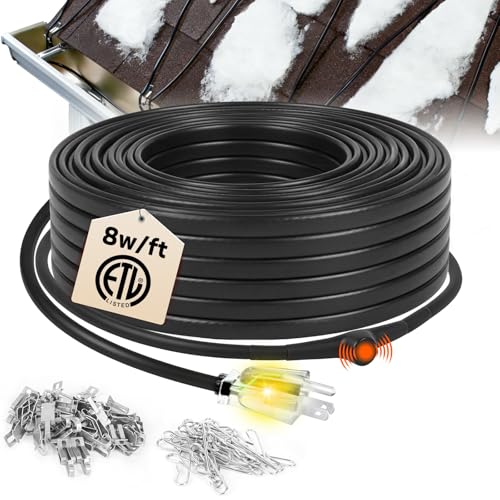
The HEATIT 8JHSF fills the pre-assembled-with-thermostat slot. It is a 50-foot self-regulating cable rated at 8 watts per foot on 120 volts, and the listing states that the cable is fully ETL certified, with a UL certified plug. What sets it apart is the control hardware at the plug end: a built-in thermostat that switches the cable on as the temperature nears freezing and off again once it warms up, plus a 10-foot lighted plug that shows at a glance whether power is reaching the cable.
That thermostat behavior is the real economy feature. A plain cable left plugged in for the season draws power through mild spells when nothing is melting; this one sits idle until the weather turns cold, then runs on its own without the owner watching forecasts. The self-regulating core adds the usual second benefit, raising output on the coldest stretches of the run and easing off where the run is warmer.
Two things to budget around. The cable is comparatively stiff and heavy for its length, which makes tight wrapping and neat corners more work. And for roof use the clips are bought separately, since the cable is sold as a general-purpose heating cable rather than a roof kit, so add a clip pack sized to the roof material before installation day.
Radiant Solutions HeatTapePro Self-Regulating Heat Cable, 50 ft

The HeatTapePro is the cable for the roofs the other kits cannot go on. Radiant Solutions states that it is certified for use on flat roofs, metal roofs, asphalt roofs, wood roofs, and rubber roofs, which makes it the only pick here whose maker names metal roofing. Owners of standing-seam and corrugated metal roofs are otherwise poorly served by plug-in kits, since the constant-wattage kits are shingle-only and warn against other surfaces.
The cable itself is self-regulating at 6 watts per foot, supplied as 50 feet of cable with a 10-foot power cord on 120 volts. Because it is self-regulating, it can be overlapped during installation without the overheating risk that rules overlap out for constant-wattage cable, which simplifies valleys and awkward junctions. Its signature feature is the GlowCap end cap, which lights to confirm that power is reaching the far end of the run, a genuinely useful check on a long or partly hidden layout. The maker also states that it operates effectively when it is 15 degrees or colder outside, and the listing carries a 10-year warranty.
The trade-offs are reach and hardware. Fifty feet is the configuration covered here, and roof clips are chosen separately to suit the roof surface, with the maker directing metal-roof installers to the clips specified for metal rather than shingle clips.
HEATIT HIRD Roof and Gutter De-Icing Cable, 240 ft

The HIRD 240 ft is the heavy-duty long-run option, built for big rooflines, long gutter systems, and properties where one cable has to do the work of several kits. It is a constant-wattage cable rated at 5 watts per foot, so the full run draws 1200 watts, a figure worth checking against the outlet circuit before installation. The listing states that the cable is ETL and CSA certified and the plug is UL certified, and the box includes the clips and spacers for the layout.
Construction is a step up from basic kits: XLPE inner insulation, aluminum foil and tinned copper braid screening, and a weather-resistant PVC outer jacket, on a 6-foot 18/3 cold lead with the plug attached. The listing also gives a pre-installation check: uncoil the cable fully, plug it in, and it should feel slightly warm within about five minutes, confirming it works before it goes on the roof.
The discipline of constant-wattage cable applies in full. No part of the heated cable may touch, cross, or overlap itself, so valleys and downspouts need care, and at just over nine pounds the coil is awkward to handle on a ladder. The listing limits it to inclined roofs with noncombustible shingles, so metal and flat roofs stay with the HeatTapePro above.
How to choose
Begin with roof material, because it rules products in or out faster than any other factor. Constant-wattage kits from Frost King and HEATIT are listed for sloped roofs with noncombustible shingles only. A metal, flat, wood, or rubber roof points to a self-regulating cable whose maker certifies it for that surface, which in this group means the HeatTapePro.
Next, measure before buying, and measure generously. Add the length of the eave, allow for the zigzag depth the maker specifies across the overhang, then add the gutter run and every downspout the cable must descend. Fixed-length kits cannot be shortened, so round up to the next size and plan the layout so extra length is absorbed by the pattern rather than coiled at the end.
Then decide how the cable will be controlled. A built-in thermostat, like the one on the HEATIT 8JHSF, runs the cable only near freezing and suits owners who will not manage it day to day. A separate automatic control or a manual routine works for the constant-wattage kits, but an uncontrolled cable left on all season wastes electricity.
Finally, treat installation as part of the purchase. Install every cable here exactly as its maker’s instructions describe, and follow local electrical rules; these are plug-in products that belong on a ground-fault protected outlet, and any hardwired control or new outdoor receptacle is a job for a licensed electrician. Buy the clips specified for your roof surface, and do the work on a clear, dry day before the first lasting snow.
Who should skip
Skip de-icing cable entirely if the real problem is attic heat loss and poor insulation. A cable manages meltwater at the eave; it does not fix the warm roof deck that creates heavy melt in the first place, and insulation and ventilation work will do more for houses with severe, recurring dams. Also skip it if a dam has already formed this season and water is entering the house now, since a cable will not remove existing ice.
Skip the constant-wattage kits if your roof is metal, flat, wood, or rubber membrane, and skip the 240-foot HIRD if the eave is short, since fixed lengths cannot be trimmed and a heavily overlong cable is hard to lay out without breaking the no-touch rule. Renters, and owners who cannot safely reach the eave with a ladder, should skip the do-it-yourself route and hire an installer instead.
Frequently Asked Questions
How long should a roof de-icing cable be?
Long enough to zigzag the full eave, run the length of the gutter, and drop down each downspout it serves, following the sizing table in the maker’s instructions. Measure the eave and overhang first, then round up to the next kit size, because these cables come in fixed lengths and cannot be cut down or spliced longer.
Can a de-icing cable go on a metal roof?
Only if the maker certifies that cable for metal roofing. Most plug-in constant-wattage kits are listed for noncombustible shingle roofs only. The Radiant Solutions HeatTapePro is certified for metal, flat, asphalt, wood, and rubber roofs, and it needs the clips the maker specifies for metal surfaces rather than shingle clips.
Do de-icing cables need a special outlet?
They are plug-in products, and makers direct owners to a ground-fault protected receptacle, installed and wired according to the cable instructions and local electrical rules. The cable must be fully uncoiled before it is powered, and any new outdoor receptacle or hardwired control should be fitted by a licensed electrician.
When should the cable be switched on?
Before the snow arrives, ideally with the cable installed on a clear day ahead of the season. The cable keeps a drainage channel open as meltwater forms; it is not built to chew through a dam that has already frozen solid. A thermostat model handles the switching itself, turning on near freezing and off as it warms.
Final verdict
Match the cable to the roof first and the length second. For a typical shingle eave, the H&G Lifestyles 50 ft self-regulating kit is the simplest capable install, and the Frost King RC160 covers longer shingle eaves in the proven constant-wattage format. The HEATIT 8JHSF earns its place where hands-off control matters, thanks to its built-in thermostat. Metal and other non-shingle roofs belong to the HeatTapePro, and the 240 ft HEATIT HIRD covers a single long roofline with one cable.
Product and ASIN Reference
| Product | ASIN |
|---|---|
| H&G Lifestyles Roof Heat Cable Snow De-icing Kit, 50 ft | B08NK22Q2X |
| Frost King RC160 Electric Roof Cable Kit, 160 ft | B00527FMMC |
| HEATIT 8JHSF Self-Regulating Heating Cable, 50 ft | B0C13TK2HR |
| Radiant Solutions HeatTapePro Self-Regulating Heat Cable, 50 ft | B01MRV9OY0 |
| HEATIT HIRD Roof and Gutter De-Icing Cable, 240 ft | B087P8SVK1 |
FAQ
How long should a roof de-icing cable be?
Can a de-icing cable go on a metal roof?
Do de-icing cables need a special outlet?
When should the cable be switched on?
More from Amazon
Programs that pair well with the guide above. Offers and eligibility are set by Amazon and may change.
Free shipping on eligible items, Prime Video and more. Eligible new members can start with a free trial.
Start a Prime free trialAudiobooks and podcasts to listen to on the go. Eligible new members can start with a free trial.
Try Audible freeAd-free music streaming. Eligible new subscribers can start with a free trial.
Try Music Unlimited freeA free business account with business pricing and bulk-buying tools for work, shop or home office.
Create a business accountAs an Amazon Associate we earn from qualifying purchases.


Write Your Review
No reviews yet. Be the first to share your experience!