
Key takeaways
- Compare the best rain jackets for hiking and outdoor use, from ultralight emergency shells to durable waterproof layers built for wet days on the trail.
A good rain jacket is the layer that decides whether a wet forecast cancels your plans or simply changes them. The best rain jackets for hiking combine a genuinely waterproof membrane, sealed seams, a hood that stays put in wind, and a packed size small enough that the jacket actually travels with you. This guide compares five waterproof shells sold on Amazon US, from ultralight emergency layers to dependable mid-range hiking jackets and one budget option to keep in a pack or car.
The five picks below cover the main ways people use a rain shell outdoors. Some are built for backpackers counting every ounce, others for day hikers who want pit zips and a roomier cut for layering, and one is a simple nonwoven jacket meant as affordable insurance against a downpour. Each entry lists verified specifications from the manufacturer’s listing and explains who the jacket suits, and who should look elsewhere.
As an Amazon Associate, we earn from qualifying purchases.
How to Choose a Rain Jacket for Hiking
Start with the waterproof construction. Most hiking rain jackets use a 2.5-layer build, where a waterproof-breathable membrane is bonded to the face fabric and finished with a thin printed inner surface. This keeps weight and packed size down, which is why most jackets in this guide use it. A durable water repellent (DWR) finish makes rain bead and roll off; when it wears down, the face fabric can wet out and feel clammy even though the membrane underneath still blocks liquid water.
Seam sealing matters as much as the membrane. Needle holes along every seam are potential leak points, so look for fully seam-taped construction if you expect sustained rain rather than brief showers. Ventilation is the second deciding factor: waterproof-breathable fabrics move only a limited amount of moisture vapor, so pit zips or underarm vents make a real difference on climbs and humid days.
Fit and features come next. A hiking shell should be roomy enough to layer over a fleece or light insulated jacket without binding at the shoulders, and the hood should adjust around a hat and move with your head. Useful details include a drawcord hem, cuff closures that seal over gloves, zippered pockets placed clear of a pack hip belt, and a design that stuffs into its own pocket. Finally, consider weight honestly: an ultralight shell you always carry protects you more than a heavier jacket left behind, but thin fabrics demand gentler treatment.
Marmot PreCip Eco Jacket

The Marmot PreCip Eco is the long-running benchmark for an affordable, fully featured hiking rain jacket, and it remains the most complete package in this guide. Its NanoPro Eco membrane is laminated to a recycled nylon ripstop face fabric with a PFC-free DWR finish, and every seam is taped. Unlike many budget shells, it includes pit zips, a genuine ventilation advantage on steep or humid trails.
The feature list is unusually complete for this class. The attached hood rolls into the collar when not needed and cinches down in wind, the chin guard is lined to reduce irritation, and the cuffs close with hook-and-loop tabs so they seal properly over light gloves. The jacket stuffs into its own pocket, and a regular fit layers comfortably over a fleece, so the PreCip Eco works as a primary three-season shell rather than only an emergency backup.
Specs
- Construction: 2.5-layer NanoPro Eco waterproof-breathable laminate
- Face fabric: Recycled nylon ripstop, PFC-free DWR finish
- Seams: Fully seam-taped
- Ventilation: Pit zips
- Hood: Attached, adjustable, rolls into collar
- Pockets: Zippered hand pockets; stuffs into own pocket
- Weight: 10.58 oz (men’s, manufacturer figure)
- Fit: Regular
Who it’s for: Hikers and backpackers who want one dependable rain jacket with real ventilation, full seam taping, and a layering-friendly fit.
Who should skip it: Ultralight purists trimming every gram, and anyone needing a shell for sustained alpine storms, where a heavier three-layer jacket holds up better.
Columbia Watertight II Jacket

The Columbia Watertight II is a straightforward, packable rain jacket for hikers and everyday users who want seam-sealed waterproof protection without a technical price tag. Columbia’s Omni-Tech membrane handles the waterproof-breathable work, and the nylon shell carries an Omni-Shield treatment that resists water absorption and stains, helping the jacket shed rain and shrug off trail grime.
A fine mesh lining separates the membrane from your layers, more comfortable than the bare printed interior of a typical 2.5-layer shell. The attached storm hood adjusts to keep rain off your face, the chin guard is abrasion resistant, and the jacket packs into its own hand pocket. At a listed weight of eight ounces, it is light enough to carry as a standby layer. There are no pit zips, so ventilation comes from the front zipper and the fabric itself.
Specs
- Construction: Omni-Tech waterproof-breathable membrane
- Shell: Nylon with Omni-Shield water- and stain-resistant treatment
- Lining: Fine mesh, polyester
- Seams: Seam-sealed
- Ventilation: None (no pit zips)
- Hood: Attached, adjustable storm hood
- Pockets: Two zippered hand pockets; packs into hand pocket
- Weight: 8 oz (listing figure)
- Model: 153389
Who it’s for: Day hikers, travelers, and commuters who want a light, packable, seam-sealed jacket for showers and short storms.
Who should skip it: Hikers who run hot on climbs and need pit zips, and anyone planning long days of continuous heavy rain.
Outdoor Research Helium Rain Jacket
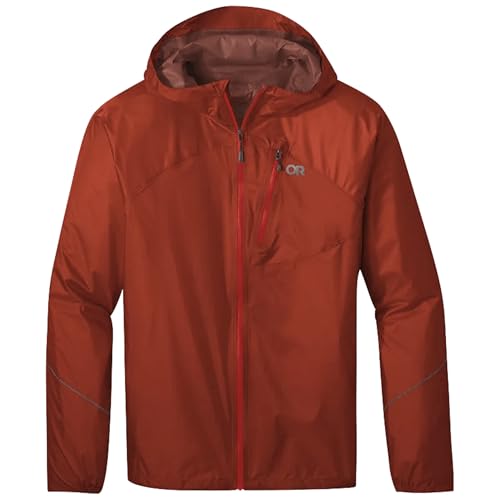
The Outdoor Research Helium Rain Jacket is the ultralight specialist of this group, built around Pertex Shield Diamond Fuse fabric in a 2.5-layer construction. Diamond Fuse yarns use diamond-shaped filaments that interlock, which Outdoor Research credits with improving abrasion resistance in a fabric this light. Fully taped seams back up the membrane, so the Helium is a true waterproof shell rather than a water-resistant wind layer.
Everything about the design is stripped back for packability. The jacket stuffs into its own chest pocket, which doubles as a stuff sack with a carabiner loop for clipping to a harness or pack. A single-pull adjustable hood, elastic cuffs, and a drawcord hem seal out wind and rain, and reflective details add low-light visibility. There are no pit zips and only minimal pocket space, the honest trade for a shell this small in a pack. It is the jacket here most likely to be with you when an unexpected storm arrives.
Specs
- Construction: 2.5-layer Pertex Shield Diamond Fuse fabric
- Face fabric: Nylon ripstop
- Seams: Fully taped
- Ventilation: None (no pit zips)
- Hood: Adjustable, single drawcord
- Pockets: Zippered chest pocket; stuffs into chest pocket, carabiner loop
- Style number: 275386
- Weight: not stated
Who it’s for: Backpackers, thru-hikers, and trail runners who prioritize the lowest possible weight and packed size in a waterproof emergency shell.
Who should skip it: Anyone who wants pit zips, multiple pockets, or a burly face fabric for bushwhacking and frequent abrasion.
Helly Hansen Loke Jacket

The Helly Hansen Loke brings a sailing-influenced design to the hiking rain jacket category, built on the brand’s Helly Tech Performance membrane in a 2.5-layer construction. The polyamide face fabric carries a PFC-free DWR finish, the seams are fully sealed, and the manufacturer rates the jacket at 10,000 mm of waterproofness with 10,000 g of moisture vapor permeability over 24 hours, squarely in the dependable mid-range for day-long rain.
Where the Loke stands out is ventilation and adjustability. Underarm zippers let you dump heat on climbs without opening the front of the jacket to the rain, a feature several competitors here leave out. A front storm flap adds a second barrier over the main zipper, and the hood, cuffs, and hem all adjust to seal the jacket down when wind drives rain sideways. The cut is cleaner and less boxy than most hiking shells, making the Loke an easy double-duty choice for travel and everyday wear in wet climates.
Specs
- Construction: 2.5-layer Helly Tech Performance fabric
- Face fabric: Polyamide, PFC-free DWR finish
- Seams: Fully seam-sealed
- Waterproof rating: 10,000 mm (manufacturer figure)
- Breathability rating: 10,000 g/m²/24h (manufacturer figure)
- Ventilation: Underarm zippers
- Hood: Adjustable
- Weight: 8.4 oz (measured, men’s)
- Model: 62252
Who it’s for: Hikers and travelers who want underarm ventilation, a clean look that works in town, and mid-range waterproof ratings.
Who should skip it: Anyone needing a shell for extreme, multi-day deluges, and hikers who want the absolute lightest option.
Frogg Toggs Ultra-Lite2 Rain Jacket

The Frogg Toggs Ultra-Lite2 takes a completely different approach from the laminated shells above. It is made from Dri2Pore, a nonwoven polypropylene fabric built in two layers, which makes it waterproof and breathable while keeping it extremely light and packable. There is no membrane to delaminate and no DWR finish to renew, so upkeep is minimal. For occasional use, that simplicity is the entire appeal.
The design is basic in a deliberate way. The hood adjusts with cord locks, the full front zipper is backed by a snap-down storm flap, and the cuffs are elastic to keep sleeves in place. A stuff sack is included, and the jacket compresses into a small bundle that fits in a pack pocket, tackle box, or car. The trade-offs are durability and refinement: nonwoven fabric can tear on sharp brush or gear, the fit is loose and unstructured, and there are no pit zips or zippered pockets. Treated as affordable, replaceable rain insurance rather than a primary technical shell, it fills its role well.
Specs
- Construction: 2-layer Dri2Pore nonwoven fabric
- Material: Polypropylene
- Ventilation: None (no pit zips)
- Hood: Adjustable with cord locks
- Closure: Full front zipper, snap-down storm flap
- Included: Stuff sack
- Model: UL62104
- Weight: not stated
Who it’s for: Occasional hikers, anglers, and anyone who wants an inexpensive, featherweight emergency rain jacket for a pack, boat, or vehicle.
Who should skip it: Frequent hikers and backpackers who need a durable primary shell, secure zippered storage, and a closer fit.
Frequently Asked Questions
What is the difference between a 2.5-layer and a 3-layer rain jacket?
A 2.5-layer jacket bonds the waterproof membrane to the face fabric and adds a thin printed inner surface to protect the membrane, keeping it light and packable. A 3-layer jacket sandwiches the membrane between the face fabric and a woven lining, which generally lasts longer and feels less clammy but weighs and costs more. For most hiking, a 2.5-layer shell is the practical choice.
Are pit zips worth it on a rain jacket?
For most active hikers, yes. Waterproof-breathable fabrics move moisture slowly, so on steep climbs or warm days your own sweat can make the inside of a jacket feel wet even when no rain gets in. Pit zips release that heat and vapor quickly without opening the front zipper to the weather. On gentle, cool-weather terrain, you may rarely miss them.
How should a rain jacket fit for hiking?
Choose a fit that lets you layer a fleece or light insulated jacket underneath without the shell pulling across the shoulders when you reach forward or raise your arms. The hem should cover your waistband, sleeves should reach your wrists with arms extended, and the hood should turn with your head. If you will wear it mostly over a single base layer, a trimmer fit is fine.
How do you restore a rain jacket’s water repellency?
When rain stops beading and the face fabric starts absorbing water, the DWR finish needs attention. Wash the jacket with a technical gear cleaner to remove dirt and oils, then tumble dry on low heat if the care label allows, since warmth often reactivates the finish. If water still does not bead afterward, apply a fresh spray-on or wash-in DWR treatment made for waterproof-breathable shells.
Final Verdict
The right rain jacket depends on how you spend your time outside. The Marmot PreCip Eco is the strongest all-rounder here, pairing pit zips, full seam taping, and a recycled ripstop shell. The Outdoor Research Helium is the pick when weight rules every decision, while the Helly Hansen Loke adds underarm ventilation and a cleaner cut for hikers who also wear their shell around town. The Columbia Watertight II covers the packable, mesh-lined middle ground for day hikes and travel, and the Frogg Toggs Ultra-Lite2 is the low-commitment emergency layer to stash wherever a storm might catch you.
Product and ASIN Reference
| Product | ASIN |
|---|---|
| Marmot Men’s PreCip Eco Jacket | B07F687RP6 |
| Columbia Men’s Watertight II Jacket | B0CLR98667 |
| Outdoor Research Men’s Helium Rain Jacket | B0CBLLH3VP |
| Helly Hansen Men’s Loke Jacket | B00EFW7Q6A |
| Frogg Toggs Men’s Ultra-Lite2 Rain Jacket | B00CLVM6D0 |
FAQ
What is the difference between a 2.5-layer and a 3-layer rain jacket?
Are pit zips worth it on a rain jacket?
How should a rain jacket fit for hiking?
How do you restore a rain jacket’s water repellency?
More from Amazon
Programs that pair well with the guide above. Offers and eligibility are set by Amazon and may change.
Free shipping on eligible items, Prime Video and more. Eligible new members can start with a free trial.
Start a Prime free trialAudiobooks and podcasts to listen to on the go. Eligible new members can start with a free trial.
Try Audible freeAd-free music streaming. Eligible new subscribers can start with a free trial.
Try Music Unlimited freeA free business account with business pricing and bulk-buying tools for work, shop or home office.
Create a business accountAs an Amazon Associate we earn from qualifying purchases.
Write Your Review
No reviews yet. Be the first to share your experience!