
Key takeaways
- Compare the best garden shovels for digging, planting and edging, from long-handle round points to root-cutting spades, with specs and buying tips.
A garden shovel is the tool that decides how a planting day feels. The wrong one turns bed prep into a fight: the blade skates off compacted soil, the handle flexes when you pry, and your back does the work the tool should be doing. The right one matches the job in front of it, because “garden shovel” covers several distinct shapes. A round point digging shovel is the generalist, built to break ground and move soil. A transplant spade has a narrower, deeper blade for slipping under root balls without wrecking neighboring plants. A square spade cuts clean edges and lifts flat slices of turf. A few specialty designs add serrated edges and V-shaped tips for ground laced with roots.
This guide compares five full-size, long-handled garden shovels sold on Amazon, one for each of those jobs. Three are Fiskars all-steel designs, which dominate this category on Amazon: a long-handle round point digger, a D-handle transplanting spade, and a flat square spade for edging. They are joined by a heavy-duty American-made round point from Bully Tools and the serrated Root Slayer from Radius Garden. Each pick gets a closer look at its construction, the specs that matter, and an honest note on who should skip it.
As an Amazon Associate, we earn from qualifying purchases.
Quick answer
For most gardeners, the Fiskars long-handle digging shovel is the safest first buy: the all-steel build, sharpened round point blade, and 57-inch handle cover general digging, hole digging, and soil turning without stooping. If you pry against rocks and roots all day, step up to the Bully Tools 82515, whose closed-back 14-gauge head and I-beam reinforced handle are built for abuse. Gardeners fighting roots should go straight to the Root Slayer, whose serrated V-tip cuts roots a smooth blade would bounce off. The Fiskars transplanting spade suits precise work around established plants, and the Fiskars square spade is the pick for crisp lawn edges and flat turf cuts.
How to Choose a Garden Shovel
Start with blade shape, because it defines the job. Round point blades penetrate and lift loose soil, so they are the default for digging holes and turning beds. Square blades slice straight lines, better for edging, trenching, and cutting sod. Narrow spade blades go deep in tight spaces, the shape you want for transplanting perennials.
Construction is the second decision. All-steel tools, where the blade and shaft are welded steel, are stiff and durable but heavier. Fiberglass handles absorb some shock and never rot, and the best ones are reinforced where the handle meets the head, since that joint is where shovels fail. Blade gauge matters too: lower gauge numbers mean thicker steel, and a 14-gauge head is a reasonable benchmark for a tool you plan to pry with.
Handle length and grip finish the picture. Long straight handles, around 57 inches, let taller users dig upright and give more leverage for prying. D-handle tools around 46 inches are easier to control in beds and borders, and oversized D grips let you push with both hands, even wearing gloves.
1. Fiskars Long Handle Digging Shovel (96685935J)

This is the all-steel generalist. The blade and shaft are welded steel rather than a blade socketed onto wood, so there is no joint to loosen over seasons of prying. The round point blade is hardened and sharpened, which helps it bite into compacted or clay-heavy soil instead of skating across the surface, and the long straight handle keeps you upright through a day of hole digging.
Fiskars rates the blade as 14-gauge hardened steel with an 18-gauge steel shaft. That combination is stiffer than a fiberglass handle of similar weight, which some gardeners prefer for prying and others find less forgiving on the hands. It is the most versatile tool here: digging, turning soil, and planting trees and shrubs are all squarely in its remit, and Fiskars backs it with a lifetime warranty.
Specs
- Blade: round point, welded 14-gauge hardened steel, sharpened edge
- Shaft: 18-gauge steel, straight handle
- Overall length: 57.5 inches
- Handle style: straight long handle
- Warranty: lifetime
- Weight: not stated
Who it’s for / who should skip
Who it’s for: homeowners who want one durable digging shovel for holes, bed turning, and planting, especially in tough or compacted soil. Who should skip: gardeners who prefer the shock absorption of fiberglass, or anyone doing tight border work where a 57-inch handle is clumsy.
2. Bully Tools 82515 14-Gauge Round Point Shovel
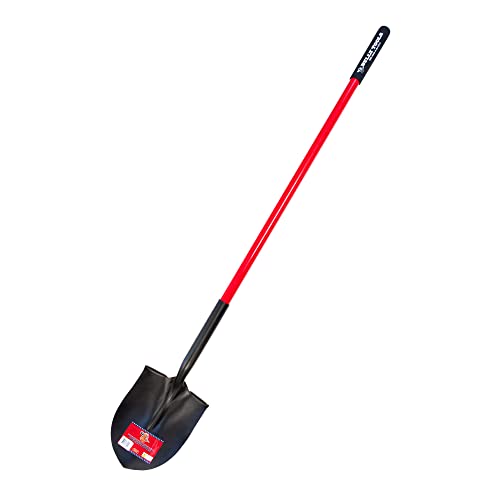
Bully Tools builds this shovel in the USA around one idea: the head and handle joint should not be the weak point. The round point head is true 14-gauge steel with a closed-back design, which adds steel behind the blade so soil does not pack into an open socket and the head resists bending under pry loads. The fiberglass handle uses triple-wall construction and a welded I-beam reinforcement along the ferrule, the exact spot where long-handle shovels usually snap.
The result is a tool aimed at heavy digging: compacted earth, small roots, trenching, and landscaping work where a bent blade ends the day. The extended foot plate gives your boot a solid landing when you drive the blade. Fiberglass also shrugs off weather that would check or rot a wood handle left in a damp shed. The trade-offs are weight and feel; reinforced fiberglass is not light, and it transmits less feedback than steel.
Specs
- Blade: round point, 14-gauge steel, closed-back design
- Handle: fiberglass, triple-wall construction, welded I-beam reinforcement
- Foot plate: extended
- Origin: made in the USA
- Overall length: not stated
- Weight: not stated
Who it’s for / who should skip
Who it’s for: gardeners and landscapers who pry against rocks and roots and want a round point shovel built to survive it. Who should skip: anyone who wants the lightest possible tool for light bed work, where this level of reinforcement is more tool than the job needs.
3. Radius Garden Root Slayer Shovel (22011)

The Root Slayer exists because a smooth round point blade is bad at one specific job: ground full of roots. Its blade ends in an inverted V cutting tip, and both edges are serrated, so when the blade meets a root it saws rather than glances off. The blade is carbon steel with a powder-coated finish to slow rust, and the shaft is a resin-encased steel core, which keeps the tool rigid when you lever a root ball loose.
At roughly 45 inches overall, it is shorter than the long-handle diggers here, which makes it handier in established beds and around shrubs, the places root problems actually live. It works as a shovel, root cutter, and transplanting tool in one, and doubles as a dividing tool for overgrown perennial clumps. The limits follow from the design: the serrated blade is not the fastest choice for moving loose soil, and Radius Garden is explicit that the tool is not intended for prying with excessive leverage.
Specs
- Blade: carbon steel, powder-coated, inverted V tip with serrated edges
- Shaft: resin-encased steel core
- Overall length: 45 inches
- Weight: 5.4 pounds
- Warranty: lifetime manufacturer promise (continental US)
- Handle grip: O-shaped poly grip
Who it’s for / who should skip
Who it’s for: gardeners clearing new beds, dividing perennials, or digging in root-infested soil where a standard shovel keeps bouncing off roots. Who should skip: anyone mainly moving loose soil or digging in clean ground, where a plain round point is faster and cheaper to maintain.
4. Fiskars 46 Inch Steel D-handle Transplanting Spade (96546925J)

Transplanting is precision work: you need to get under a root ball, lift it intact, and avoid slicing the roots of everything planted next to it. This spade is shaped for that. The blade is narrower than a digging shovel’s and welded from 14-gauge steel, with a sharpened edge for cutting a clean plug of soil around a plant. The 18-gauge steel shaft has a teardrop profile, shaped to fit the natural motion of the hand, and the extra-large D-handle gives secure two-handed control, even with gloves on.
At 46 inches, the tool is short enough to steer in crowded borders but still long enough to dig standing up. The listing highlights digging small, deep holes and digging up bulbs, and that is the honest use case: bulbs, perennials, and shrubs in established beds. It is not a bulk soil mover, and the narrow blade makes it slow for digging a new bed from scratch.
Specs
- Blade: narrow spade, welded 14-gauge steel, sharpened edge
- Shaft: 18-gauge steel, teardrop-shaped profile
- Handle: extra-large D-handle
- Overall length: 46 inches
- Warranty: lifetime
- Weight: not stated
Who it’s for / who should skip
Who it’s for: gardeners who transplant perennials, divide plants, and dig bulbs in established beds and want control over raw digging power. Who should skip: anyone breaking new ground or digging large holes, where a round point digging shovel will move soil far faster.
5. Fiskars 46 Inch Steel Square Garden Spade

A square spade looks like a digging shovel that lost its point, and that flat edge is the whole idea. It cuts straight lines: the edge of a lawn where it meets a bed, the sides of a trench, or flat slices of sod you want to lift and relay. This Fiskars version uses the same welded all-steel construction as its siblings, with a teardrop-shaped shaft and an oversized D-handle for two-handed control when you push the blade through turf.
Specs
- Blade: flat square spade, welded steel, sharpened edge
- Shaft: steel, teardrop-shaped profile
- Handle: oversized D-handle
- Overall length: 46 inches
- Warranty: lifetime
- Weight: not stated
Who it’s for / who should skip
Who it’s for: gardeners who edge lawns, cut sod, and dig flat-bottomed trenches and want clean, straight cuts. Who should skip: anyone whose main job is breaking hard ground or digging planting holes, where a round point blade is the better tool.
Frequently Asked Questions
What is the difference between a shovel and a spade?
In garden tool terms, a shovel usually has a pointed or curved blade for digging and moving soil, while a spade has a flatter, straighter blade for cutting edges, slicing sod, and transplanting. The names overlap on listings, so shop by blade shape: round point for digging, flat for edging, narrow for transplanting.
Which handle material is best for a garden shovel?
Steel is the stiffest and most durable, and welded all-steel tools have no joint to loosen, but they are heavier and transmit more shock. Fiberglass is lighter, weatherproof, and absorbs some impact, though reinforced designs hold up far better than basic ones. Wood is comfortable and repairable but needs dry storage to avoid rot and checking.
How long should a garden shovel be?
Long handles around 57 inches suit taller users and heavy digging, since they let you work upright and pry with leverage. D-handle tools around 46 inches are easier to control in beds, borders, and tight spaces. If you do both kinds of work, a long-handle digger plus a shorter spade covers more than one compromise length.
How do I keep a steel shovel blade in good shape?
Scrape off soil after use, dry the blade, and wipe it with an oily rag before storage to slow rust on carbon and hardened steel blades. A few passes with a file along the edge restores the bite on a sharpened digging blade. Store the tool out of standing moisture.
Final verdict
Match the blade to the job and any of these five will earn its space in the shed. The Fiskars long-handle digging shovel is the best single buy for general digging and planting. The Bully Tools 82515 is the heavy-duty step up for rocky, compacted ground. The Root Slayer is the specialist for root-filled beds, the Fiskars transplanting spade handles precise work around established plants, and the Fiskars square spade keeps edges and trenches clean. Gardeners who dig often will eventually want a round point plus one specialist; everyone else can start with the Fiskars digger and add from there.
Product and ASIN Reference
| Product | ASIN |
|---|---|
| Fiskars Long Handle Digging Shovel (96685935J) | B000B6Q6BA |
| Bully Tools 82515 14-Gauge Round Point Shovel | B002YOTA7E |
| Radius Garden Root Slayer Shovel (22011) | B01M1CCIWH |
| Fiskars 46 Inch Steel D-handle Transplanting Spade (96546925J) | B000F95D0I |
| Fiskars 46 Inch Steel Square Garden Spade | B000BX4SLS |
FAQ
What is the difference between a shovel and a spade?
Which handle material is best for a garden shovel?
How long should a garden shovel be?
How do I keep a steel shovel blade in good shape?
More from Amazon
Programs that pair well with the guide above. Offers and eligibility are set by Amazon and may change.
Free shipping on eligible items, Prime Video and more. Eligible new members can start with a free trial.
Start a Prime free trialAudiobooks and podcasts to listen to on the go. Eligible new members can start with a free trial.
Try Audible freeAd-free music streaming. Eligible new subscribers can start with a free trial.
Try Music Unlimited freeA free business account with business pricing and bulk-buying tools for work, shop or home office.
Create a business accountAs an Amazon Associate we earn from qualifying purchases.

Write Your Review
No reviews yet. Be the first to share your experience!