
Key takeaways
- Compare the best garden hoes for weeding and soil work, from an adjustable stirrup hoe to a forged field hoe, a two-prong hoe and a Japanese hand hoe.
A garden hoe is not one tool but a family of tools, and the head shape decides how it works. A stirrup hoe skims just below the soil surface and slices weed stems on both the push and the pull, making it fast and gentle in established beds. A draw hoe or field hoe works the opposite way, chopping into compacted ground to break up clods, cut roots and clear rough patches. Between those poles sit specialty shapes — the enclosed V-blade push-pull hoe, the two-prong weeding hoe and the short Japanese hand hoe.
This guide compares five garden hoes sold on Amazon, one for each main working style: an adjustable stirrup hoe for bed maintenance, a heavy field hoe for clearing and chopping, an enclosed-blade push-pull hoe for weeding close to plants and drip lines, a two-prong hoe for tight beds, and a Japanese sickle hand hoe for detail weeding where no long handle can reach.
As an Amazon Associate, we earn from qualifying purchases.
Quick answer
For most home gardeners, the DonSail scuffle hoe is the safest first buy: its loop blade cuts on both strokes, the handle adjusts to three lengths, and it weighs about a pound. If your ground is rough or compacted, skip straight to the Rogue Hoe field hoe, built to chop rather than slice. Gardeners who weed around drip irrigation should look at the Hoss push-pull hoe, tight-bed workers at the Bully Tools two-prong hoe, and detail workers at the TOYPOPOR hand hoe.
1. DonSail Scuffle Hoe, Adjustable 30 to 61 Inch
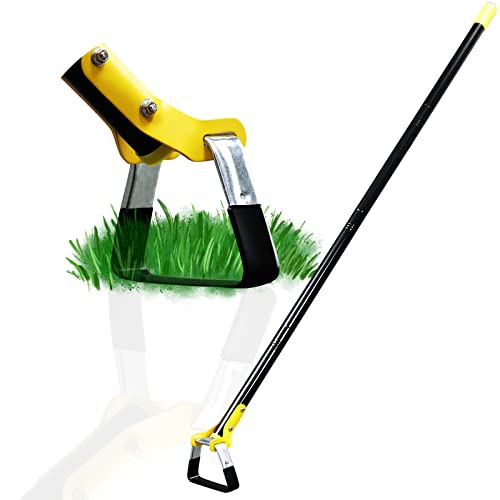
The DonSail is the adjustable stirrup hoe that shows up in more gardens than any other. Its loop-shaped head works with a push-pull motion, cutting weed roots just below the surface on both strokes instead of relying on a chop. Because the blade skims rather than digs, it can run close to live plants and bed edges with far less risk of tearing up the crops you meant to keep.
The handle assembles from three steel sections to give working lengths of 30, 43 or 60 inches, so the same tool shortens for raised beds or lengthens for standing weeding down a row. The listing describes commercial-grade, extra-thick steel tubing with a hollow design, keeping the tool at about one pound.
The limits follow from the format: a loop hoe skims and bounces over hard-packed clay, thick roots and woody stems rather than cutting through them, and the screw-together sections can work loose over time.
Specs
- Head type: stirrup (scuffle) loop blade, push-pull action
- Handle: steel, sectional, adjusts to 30, 43 or 60 inches
- Weight: about 1 pound
- Blade width: not stated
Who it’s for / who should skip
Who it’s for: home gardeners who weed vegetable beds, flower borders and raised beds regularly and want one light, adjustable tool. Who should skip: anyone breaking new ground, clearing woody weeds, or working hard clay, where a chopping hoe does in minutes what this blade cannot do at all.
2. Rogue Hoe Field Hoe with 5-1/2 Inch Head, 40 Inch Hickory Handle

The Rogue Hoe field hoe is the chopper of this guide. Its 5.5 inch head is set for draw-hoe work — pulling through soil, chopping weeds and roots, hilling rows and clearing ground that a stirrup blade would skate across. The maker’s description is blunt about the intent: the tool is built for clearing fire lines and can cut saplings up to an inch in diameter, which places it in land-clearing territory rather than flower-bed maintenance.
Construction is old-school and repairable. The head joins the 40 inch hickory handle with a welded ferrule, secured three ways — rivet, adhesive and pressure fit — so it stays tight under repeated impact. Hickory is the classic handle wood for striking tools because it absorbs shock well, and at 40 inches the handle gives a compact, controlled swing for brush and established plantings.
That focus is also the trade-off: this head is too aggressive for gentle cultivation around seedlings, the shorter handle means more bending on long rows than a 54 inch draw hoe, and a chopping edge needs regular sharpening.
Specs
- Head type: field (draw) hoe, chopping action
- Head width: 5.5 inches
- Handle: hickory, 40 inches
- Head connection: welded ferrule, secured by rivet, adhesive and pressure fit
- Head material: not stated
Who it’s for / who should skip
Who it’s for: gardeners and smallholders clearing rough patches, cutting roots, hilling potatoes and maintaining ground where weeds get woody. Who should skip: anyone whose weeding is mostly light maintenance in soft, mulched beds — a stirrup hoe will be faster and kinder there.
3. Hoss Tools Push Pull Hoe

The Hoss push-pull hoe takes a different approach to slicing. Instead of an open loop, its head is a sharpened V-shaped blade of tempered steel that slides across the ground, undercutting weeds as it goes. The enclosed V shape is the point: the blade can pass close to plant stems and slide underneath drip irrigation lines without nicking the tape or cutting the crop — the standing worry with open stirrup hoes in intensively planted beds.
Hoss describes the action as sliding rather than chopping: you move the head back and forth at ground level and let the sharpened edges do the work, keeping soil disturbance low over long rows. The hoe is made in the USA, described by the maker as Amish-made and built to last, with a tempered steel head that can be resharpened as it dulls.
The caveats are about scope and information. Like every slicing hoe here, it is a weeding tool, not a ground-breaker: compacted, root-bound soil will stop it. The listing is also thinner on dimensions than most — handle length and weight are not stated, so buyers who need an exact working length should confirm it before ordering.
Specs
- Head type: push-pull hoe with enclosed V-shaped blade
- Head material: tempered steel, sharpenable
- Model: PPH994
- Origin: made in USA
- Handle length: not stated
- Weight: not stated
Who it’s for / who should skip
Who it’s for: market gardeners and serious home growers who weed long rows planted with drip irrigation, and anyone who has nicked a tape line with an open loop hoe. Who should skip: buyers clearing rough or compacted ground, and anyone who needs confirmed handle dimensions before buying.
4. Bully Tools 12-Gauge Two-Prong Weeding Hoe, 58 Inch Fiberglass Handle

The Bully Tools two-prong hoe is the precision pick. Its head is a pair of prongs rather than a blade — 3.75 inches across — designed to work into beds, loosen soil and pull weeds in the tight spaces between plants where a wide hoe head cannot fit without doing damage. It follows the old two-prong tradition: slower than a blade across open ground, far more accurate inside a planted bed.
The build is commercial grade. The head is extra-thick 12-gauge steel, the handle is fiberglass with triple-wall construction, and an extended steel ferrule reinforces the joint between head and handle — the point that fails first on cheaper long-handled tools. At 58 inches the handle allows standing work along rows and bed edges, and the fiberglass will not splinter, swell or rot. The tool is made in the USA.
The trade-offs are coverage and soil type. Two prongs move far less soil per stroke than a 6 inch blade, so clearing an open patch is slow work, and in very hard, dry ground the prongs can skate where a heavy chopping head would bite. Treat it as the second hoe in the shed — the one for in-bed work — rather than the only one.
Specs
- Head type: two-prong weeding hoe
- Head width: 3.75 inches
- Head material: 12-gauge steel
- Handle: fiberglass, triple-wall construction, 58 inches
- Origin: made in USA
Who it’s for / who should skip
Who it’s for: gardeners with densely planted beds who need to weed and cultivate between plants without tearing roots, and anyone who wants a fiberglass handle that ignores weather. Who should skip: anyone clearing open ground or large weedy patches, where a wide draw or stirrup head covers the same area in a fraction of the strokes.
5. TOYPOPOR Japanese Weeding Sickle Hoe, 14 Inch Hand Hoe

The TOYPOPOR is the hand hoe of the guide — a Japanese-style sickle hoe, or kama, built for the work no long handle can do. Its curved blade works with a pulling scrape, slicing weeds at the surface in cracks along walkways, under low shrub branches, around stepping stones and inside tight planting pockets. The elbow-shaped design lets the blade dig with its flat edge or work with its pointed tip, useful for prying out weeds in gravel and loosening soil in containers.
The blade is high carbon steel in a double-layer construction, made to be resharpened and polished back to a keen edge over years of use rather than replaced. Dimensions are compact: a 4.8 inch blade, a 10.2 inch handle and about 13.4 inches overall, at roughly 0.4 pounds. It rides in a bucket or tool belt and comes out for the detail work that finishes a bed after the long-handled hoe has done the bulk of it.
The limits are plain. You will be kneeling or crouching to use it, it clears a few inches at a time, and it cannot break ground or substitute for a standing hoe on a real plot.
Specs
- Head type: Japanese sickle hand hoe (kama), curved blade with elbow design
- Blade: high carbon steel, double-layer construction, 4.8 inches
- Handle: 10.2 inches
- Overall length: about 13.4 inches
- Weight: about 0.4 pounds
Who it’s for / who should skip
Who it’s for: gardeners who finish beds by hand — weeding pavers, gravel, tight corners and around individual plants. Who should skip: anyone looking for a standing weeding tool or a way to clear a whole plot; this is a close-up instrument, and a long-handled hoe should do the heavy work first.
Frequently Asked Questions
What is the difference between a stirrup hoe and a draw hoe?
The action. A stirrup hoe has a looped blade that moves parallel to the surface in a push-pull motion, slicing weed stems just below ground level with minimal soil disturbance. A draw hoe has a solid blade set at an angle and works with a chopping, pulling stroke that digs into the soil. Stirrup hoes suit maintained beds and loose soil; draw hoes suit clearing and heavier weeds.
Which garden hoe is best for weeding around drip irrigation?
An enclosed-blade design such as the Hoss push-pull hoe, whose V-shaped head is made to slide under drip lines without nicking them and to pass close to stems. Open stirrup hoes also work if you slow down near the lines, but the enclosed blade gives a margin of safety in densely planted rows.
How do I keep a garden hoe blade sharp?
A few strokes with a flat mill file restores most hoe edges: file the bevel at its existing angle and stop when the edge feels keen rather than razor sharp — a working edge survives soil and stones better. Wipe the blade dry after use and store the tool out of the rain to slow rust.
Can one garden hoe do every job?
Not well. Slicing hoes cannot break hard ground, chopping hoes are clumsy and risky between delicate plants, and hand hoes only cover detail work. Most gardeners end up with two: a long-handled hoe matched to their soil, plus a short hand hoe for edges and corners.
Final verdict
Match the hoe to the action your soil demands. For routine weeding in worked beds, the DonSail stirrup hoe is the right default: light, adjustable and gentle around plants. For rough or compacted ground, the Rogue Hoe field hoe is the honest tool, built to chop where slicers bounce. Growers working around drip lines should choose the Hoss push-pull hoe, densely planted beds reward the Bully Tools two-prong hoe, and the TOYPOPOR sickle hoe earns a place in every kit as the detail tool for the last few inches no long handle can reach.
Product and ASIN Reference
| Product | ASIN |
|---|---|
| DonSail Scuffle Hoe, Adjustable Weeding Loop Stirrup Hoe, 30-61 Inch | B09DVSB4BS |
| Rogue Hoe Field Hoe with 5-1/2 Inch Head, 40 Inch Hickory Handle | B07GQS4274 |
| Hoss Tools Push Pull Hoe (PPH994) | B01KINA8NW |
| Bully Tools 12-Gauge Two-Prong Weeding Hoe, 58 Inch Fiberglass Handle | B0031575JA |
| TOYPOPOR Japanese Weeding Sickle Hoe, 14 Inch Hand Hoe Sickle | B0BWHVHNNM |
FAQ
What is the difference between a stirrup hoe and a draw hoe?
Which garden hoe is best for weeding around drip irrigation?
How do I keep a garden hoe blade sharp?
Can one garden hoe do every job?
More from Amazon
Programs that pair well with the guide above. Offers and eligibility are set by Amazon and may change.
Free shipping on eligible items, Prime Video and more. Eligible new members can start with a free trial.
Start a Prime free trialAudiobooks and podcasts to listen to on the go. Eligible new members can start with a free trial.
Try Audible freeAd-free music streaming. Eligible new subscribers can start with a free trial.
Try Music Unlimited freeA free business account with business pricing and bulk-buying tools for work, shop or home office.
Create a business accountAs an Amazon Associate we earn from qualifying purchases.


Write Your Review
No reviews yet. Be the first to share your experience!