
Our Short List of 3

- Best for: Couples who want supportive framed seats for long, relaxed lake and slow-river outings.
- Length: 13 ft 5 in
- Width: 33.75 in
- Boat weight: 67 lb
- Maximum capacity: 500 lb

- Best for: Stability-first couples and casual anglers on ponds, small lakes, and gentle rivers.
- Length: 10 ft
- Width: 36 in
- Item weight: 60 lb
- Maximum capacity: 500 lb
- Best for: Heavier pairs, or a grandparent paddling with a grandchild, who want maximum capacity headroom.
- Length: 13 ft 6 in
- Width: 34 in
- Deck height: 15.5 in
- Boat weight: 78 lb
All 4 Picks at a Glance
| Product | Specs | Action |
|---|---|---|
| Perception Tribe 13.5 |
| Check price on Amazon |
| Lifetime Sport Fisher |
| Check price on Amazon |
| Perception Rambler 13.5 |
| Check price on Amazon |
 Driftsun Rover 220 |
| Check price on Amazon |
Key takeaways
- Stable hulls, supportive seats and weights two people can lift: four tandem kayaks compared for older paddlers, with specs taken from each Amazon listing.
For older paddlers, the real decision is rarely about speed. It is whether you can climb in and out without a wrestling match, sit through an hour on the water without your back complaining, and still get the boat onto the car afterward with your partner’s help. A tandem spreads the paddling effort between two people, which helps, but hull weight, seat design, and stability matter far more at sixty-five than they did at thirty-five.
This guide is for retired couples, grandparents who paddle with family, and older beginners who want calm-water confidence. Every pick was chosen from the names and specifications on its Amazon product page: open sit-on-top decks that are easy to board, supportive seats, stable hull shapes, and one inflatable that removes the lifting problem altogether.
Quick Picks
As an Amazon Associate we earn from qualifying purchases
| Product | Best for | Key spec from title |
|---|---|---|
| Perception Tribe 13.5 | Couples who spend long mornings on lakes | 13.5 ft sit-on-top with large rear storage |
| Lifetime Sport Fisher | Stability-first pairs who also fish casually | 10 ft tandem kayak with paddles included |
| Perception Rambler 13.5 | Heavier pairs who need capacity headroom | 13.6 ft hull with storage and tie downs |
| Driftsun Rover 220 | Anyone who cannot lift a hardshell kayak | Inflatable with high-pressure dropstitch floor |
How to Choose
Entry and Exit: Open Decks Win
A sit-on-top kayak has no enclosed cockpit to fold yourself into, and that single difference decides most senior purchases. You sit down from a dock or shoreline the way you would sit on a bench, swing your legs over the side, and you are in. Getting out reverses the motion, with no need to push up out of a deep cockpit using only your arms. Sit-inside tandems paddle efficiently, but their cockpit openings punish stiff knees and hips. Unless you specifically want weather protection, the open deck is the safer default for older joints.
Hull Weight and the Two-Person Carry
Tandem hardshells in this guide weigh between 60 and 78 pounds, and that number governs how often the kayak actually gets used. Split between two adults using the bow and stern handles, a 60-pound hull means roughly 30 pounds per person, which most couples manage. At 78 pounds, roof loading becomes a planned exercise rather than an impulse. Check the listed boat weight before buying, think honestly about the carry from car to water, and consider a kayak cart. The inflatable in this guide sidesteps the issue at 28 pounds in a carry bag.
Seats and Back Support
A flat molded seat pan is tolerable for twenty minutes and miserable for two hours. Look for padded seats with a real backrest, ideally adjustable or framed, because lower-back support is what turns a short outing into a relaxed morning. Framed seats like the Tribe’s sit you slightly higher, which also makes standing up at the end easier. Movable backrests, like the Lifetime’s, let you shift seating positions when paddling solo. Whatever the design, confirm from the listing what seating is actually included, because some tandems ship with simple pads rather than full seats.
Stability and Capacity Headroom
Width and hull shape decide how secure a kayak feels when you shift your weight or reach for a dropped hat. Hulls around 34 to 38 inches wide, tunnel hulls, and inflatable tubes all resist tipping far better than narrow touring shapes. Capacity matters just as much: add both paddlers’ weights plus gear, then compare against the listed maximum. A boat loaded near its limit sits low and feels sloppy. Keeping your combined load comfortably under the maximum, as the Rambler’s 550-pound rating allows for most couples, keeps the hull riding high and predictable.
The 4 Best Options
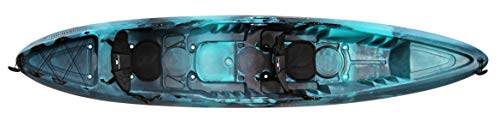
Perception Tribe 13.5
- Best for: Couples who want supportive framed seats for long, relaxed lake and slow-river outings.
- Length: 13 ft 5 in
- Width: 33.75 in
- Boat weight: 67 lb
- Maximum capacity: 500 lb
Couples who want supportive framed seats for long, relaxed lake and slow-river outings.
Listed boat weight varies between model years in some sources, so confirm the weight shown on the current listing if you plan to load it with minimal help.
The Tribe 13.5 is the comfort pick for couples who measure outings in hours rather than minutes. Its framed seats have high backs with multiple recline positions, so neither paddler spends the morning perched on a flat plastic pan, and the raised seating makes the final stand-up at the dock noticeably easier. The 33.75-inch-wide hull and 500-pound capacity cover two adults plus a small grandchild or dog in the middle, and the open sit-on-top deck means boarding is a sit-and-swing motion rather than a climb. A large rear tankwell with tie-downs swallows a cooler and dry bags.
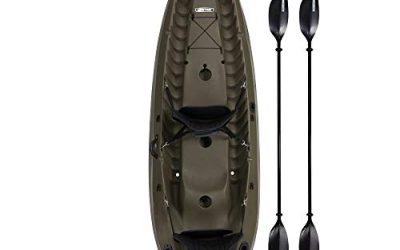
Lifetime Sport Fisher
- Best for: Stability-first couples and casual anglers on ponds, small lakes, and gentle rivers.
- Length: 10 ft
- Width: 36 in
- Item weight: 60 lb
- Maximum capacity: 500 lb
Stability-first couples and casual anglers on ponds, small lakes, and gentle rivers.
The short, wide hull trades speed and tracking for that stability, so it feels slow on long lake crossings.
If feeling steady matters more than covering distance, the Sport Fisher’s tunnel hull is the most reassuring shape in this guide. Lifetime describes that hull as stable enough to sit side-saddle without tipping, and the tiered seating keeps both paddlers riding high and dry. At 60 pounds it is the lightest hardshell here, and unusually for this category it arrives with two paddles and two padded backrests included, so there is nothing extra to buy before the first outing. Three seating positions let it work solo or tandem, and three flush-mount rod holders suit couples who cast a line while they drift.
Perception Rambler 13.5
- Best for: Heavier pairs, or a grandparent paddling with a grandchild, who want maximum capacity headroom.
- Length: 13 ft 6 in
- Width: 34 in
- Deck height: 15.5 in
- Boat weight: 78 lb
Heavier pairs, or a grandparent paddling with a grandchild, who want maximum capacity headroom.
At 78 lb it is the heaviest hardshell in this guide, so plan on a cart for the parking-lot carry and two-person roof loading; paddles are not listed as included.
The Rambler 13.5 answers a specific worry: two larger adults plus gear can push a tandem close to its limit, and a hull riding low feels nervous. Its 550-pound listed capacity is the highest among the hardshells here, which keeps the boat sitting higher and steadier under heavier crews. Adjustable padded seating and multiple molded footrests let both paddlers brace properly, the center seating area allows solo paddling or a small passenger, and the open rear deck with tie-downs handles picnic gear. Like the Tribe, the sit-on-top layout keeps entry and exit simple for stiff knees.
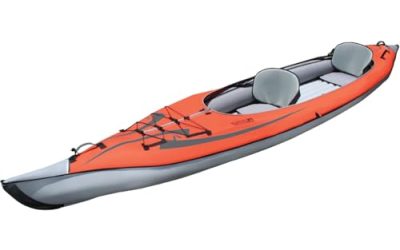
Driftsun Rover 220
- Best for: Seniors without a roof rack, or with limited lifting strength, who still want a full-size tandem.
- Length: 12 ft 6 in (inflated)
- Width: 38 in
- Weight: 28 lb
- Maximum capacity: 600 lb
Seniors without a roof rack, or with limited lifting strength, who still want a full-size tandem.
Reaching full floor pressure with the included hand pump takes real effort, so many owners add an electric pump; keep the PVC clear of sharp dock hardware and rocky shorelines.
The Rover 220 solves the problem that stops many older couples from buying a kayak at all: it weighs 28 pounds and travels in the included bag, so there is no roof rack, no overhead lifting, and no trailer. Its high-pressure dropstitch floor inflates to a rigid platform in about nine minutes, the 38-inch width and 600-pound capacity give it a planted, confidence-inspiring feel, and the padded seats have high backs for support. Two aluminum paddles, a hand pump, and a travel bag are all in the box. For seniors with limited lifting strength, this is the realistic route to the water.
Which One Fits Your Situation
You Paddle Together Every Weekend
Choose the Perception Tribe 13.5. Frequent outings reward the framed, reclining seats more than any other feature here, because back comfort is what decides whether the second hour feels pleasant or punishing. The 500-pound capacity covers most couples with room for a cooler, and the rear tankwell keeps picnic gear secure behind the stern paddler.
Your Partner Sometimes Stays Home
Choose the Perception Rambler 13.5. Its center seating area is designed for solo paddling, so the kayak trims properly with one person aboard instead of wallowing bow-high. The Lifetime Sport Fisher also converts between solo and tandem seating, and its movable backrests make the swap simple, but the Rambler’s capacity and footrest options suit dedicated solo days better.
Balance Feels Less Certain Than It Used To
Choose the Lifetime Sport Fisher. The tunnel hull was built for steadiness above all else, to the point where sitting side-saddle or turning to reach gear does not unsettle it. Tiered seating keeps you high and dry, the 36-inch beam adds further reassurance, and at 60 pounds it is also the easiest hardshell here to move around on land.
The Car Has No Roof Rack
Choose the Driftsun Rover 220. It packs into a bag that rides in the trunk or back seat, inflates at the shoreline in about nine minutes, and at 28 pounds one person can carry the whole package from car to water. No other pick in this guide removes the transport problem so completely.
Common Mistakes
- Choosing a sit-inside tandem with small cockpit openings when stiff knees or hips make climbing in and out the hardest part of the day.
- Adding both paddlers’ weights together, seeing a number close to the listed capacity, and buying anyway; a hull loaded to its maximum rides low and feels unstable.
- Ignoring boat weight until the first attempt at lifting a 78-pound hull onto a roof rack in a hot parking lot.
- Assuming paddles are included; most hardshell tandems list them separately, and only the Lifetime and Driftsun picks here include them.
- Skipping a kayak cart because the launch looked close on the map, then facing a long carry over gravel or sand.
Frequently Asked Questions
Is a sit-on-top or sit-inside kayak easier for seniors?
For most older paddlers, sit-on-top is easier. There is no cockpit to climb into or extract yourself from; you sit down, swing your legs aboard, and reverse the process at the dock. The trade-off is more splash and sun exposure, which is why every hardshell in this guide uses an open deck.
How heavy is too heavy for two older adults to load?
There is no universal number, but the practical test is the roof of your car, not the showroom floor. A 60-pound hull split between two people using the end handles is manageable for most couples. At 78 pounds, add a kayak cart and load from the rear, or choose the 28-pound inflatable instead.
Can one person paddle a tandem kayak alone?
Yes, provided the kayak offers a center seating position. The Rambler 13.5 has a dedicated center seating area, and the Sport Fisher’s three tiered positions with movable backrests are designed for solo or tandem use. Sitting in the middle keeps the hull level, so it tracks far better than paddling a tandem from the rear seat alone.
Are inflatable kayaks stable enough for older paddlers?
A well-made inflatable like the Rover 220 can feel steadier than a narrow hardshell. Wide tubes and a 38-inch beam resist tipping, and the dropstitch floor inflates rigid so the boat does not flex under you. The real checks are inflating to the listed pressures and staying off sharp rocks and barnacled docks that can puncture PVC.
FAQ
Is a sit-on-top or sit-inside kayak easier for seniors?
How heavy is too heavy for two older adults to load?
Can one person paddle a tandem kayak alone?
Are inflatable kayaks stable enough for older paddlers?
More from Amazon
Programs that pair well with the guide above. Offers and eligibility are set by Amazon and may change.
Free shipping on eligible items, Prime Video and more. Eligible new members can start with a free trial.
Start a Prime free trialAudiobooks and podcasts to listen to on the go. Eligible new members can start with a free trial.
Try Audible freeAd-free music streaming. Eligible new subscribers can start with a free trial.
Try Music Unlimited freeA free business account with business pricing and bulk-buying tools for work, shop or home office.
Create a business accountAs an Amazon Associate we earn from qualifying purchases.

Write Your Review
No reviews yet. Be the first to share your experience!