
Our Short List of 3

- Best for: Solo paddlers who want a real center seat and the lightest hard-shell carry in this group.
- Length: 13 ft 5 in
- Width: 34 in
- Boat weight: 67 lb
- Maximum capacity: 500 lb
- Best for: Bigger paddlers and gear-heavy solo trips that still need a genuine two-person layout on family days.
- Length: 13 ft 6 in (162 in)
- Width: 34 in
- Deck height: 15.5 in
- Boat weight: 78 lb

- Best for: Solo anglers who want tandem capacity, a stand-to-cast deck, and rod storage already fitted.
- Length: 12.5 ft
- Beam: 34 in
- Maximum capacity: 600 lb
- Seating for 2 to 3 people, with a one-paddler layout
All 4 Picks at a Glance
| Product | Specs | Action |
|---|---|---|
| Perception Tribe 13.5 |
| Check price on Amazon |
| Perception Rambler 13.5 |
| Check price on Amazon |
| BKC Brooklyn 12.5 Tandem |
| Check price on Amazon |
 Intex Excursion Pro K2 |
| Check price on Amazon |
Key takeaways
- Compare tandem kayaks one person can paddle solo, with center or movable seats, stated capacities, and the checks that matter before you buy.
Buying a tandem kayak you plan to paddle alone sounds like a compromise, but the real decision is narrower: does the boat give you a proper seat near the middle of the hull? A tandem paddled from the rear seat sits bow-high and wanders in wind, while a hull with a genuine center or movable seat position trims level and tracks the way the designer intended.
This shortlist is for buyers who paddle solo most weekends but still want a second seat for a partner, child, or dog on others. Every model below is a two-person kayak whose listing states a solo seating arrangement, and the picks were chosen from the dimensions, capacities, and seat details printed in their Amazon listings.
Quick Picks
As an Amazon Associate we earn from qualifying purchases
| Product | Best for | Key spec from title |
|---|---|---|
| Perception Tribe 13.5 | Solo paddling from a molded center seat | 500 lb max capacity |
| Perception Rambler 13.5 | A documented solo setup with the most load headroom of the hard shells | 550 lb max capacity |
| BKC Brooklyn 12.5 Tandem | Solo fishing trips with a full second seat kept free | 600 lb capacity, 6 rod holders |
| Intex Excursion Pro K2 | Apartment storage and car-trunk transport | 400 lb capacity, paddles and pump included |
How to Choose
Start with the solo seat position, not the seat count
Plenty of tandems claim a third passenger spot, yet only some are laid out for one paddler. Look for wording in the listing that describes a center seat, a seat that clips into a middle position, or a configuration built for one, two, or three paddlers. Sitting near the hull’s midpoint keeps your weight over the widest, most buoyant part of the boat, so the bow stays down and each stroke drives the kayak forward instead of swinging the nose sideways. If the listing only shows two fixed seats, expect to paddle from the back with the front riding light and skittish.
Match the stated capacity to your solo load
Capacity figures on tandem listings assume the weight is spread along the hull. Paddling alone concentrates you, your cooler, and your tackle in one zone, so leave a wider margin than the headline number suggests. Add your body weight, a full day bag, water, and fishing or picnic gear, then compare the total with the stated maximum. A boat rated well above your solo load also leaves room for the second paddler it was bought for, while a hull you already load near its limit alone will feel wallowy and sit low with two aboard.
Weigh the hull you will move by yourself
A tandem bought for solo use also gets loaded onto the car, carried to the launch, and dragged up the bank by one person. Hull weights in this class run from the high sixties to around eighty pounds, and length matters as much as mass: a 13.5-foot boat is awkward on a windy roof rack no matter how strong you are. Check the listed weight and dimensions against your vehicle and storage space, and budget for a kayak cart if the launch involves a long path. An inflatable sidesteps most of this, at the cost of setup time.
Decide between hard shell and inflatable honestly
Rotomolded hard shells shrug off docks, oyster beds, and gravel launches, and they are ready the moment they slide off the rack. Inflatables trade that toughness and glide for storage in a closet and transport in a trunk, plus a softer, wider platform that feels forgiving to new paddlers. Neither is better in the abstract. The right call depends on where the kayak will live between trips and how rough your usual shoreline is, so weigh your garage, your car, and your launch sites before falling for either format.
The 4 Best Options
Perception Tribe 13.5
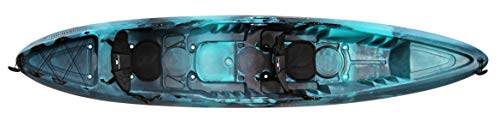
- Best for: Solo paddlers who want a real center seat and the lightest hard-shell carry in this group.
- Length: 13 ft 5 in
- Width: 34 in
- Boat weight: 67 lb
- Maximum capacity: 500 lb
Solo paddlers who want a real center seat and the lightest hard-shell carry in this group.
Scupper plugs are sold separately, and the listing does not bundle paddles, so budget for both.
The Tribe 13.5 is the cleanest answer to the solo-tandem problem because its three-seat layout was designed with a lone paddler in mind: Perception’s own documentation describes paddling solo from the center seat, with two adults plus a small child or pet as the crewed alternative. Framed seatbacks with adjustable support and cushioned seat pans suit long, slow days, and the front and rear tank wells swallow a crate and a dry bag without crowding your feet. At 67 pounds it is also the lightest hard shell here, which matters every time you load it alone.
Perception Rambler 13.5
- Best for: Bigger paddlers and gear-heavy solo trips that still need a genuine two-person layout on family days.
- Length: 13 ft 6 in (162 in)
- Width: 34 in
- Deck height: 15.5 in
- Boat weight: 78 lb
Bigger paddlers and gear-heavy solo trips that still need a genuine two-person layout on family days.
The solo layout requires fitting the deck loops before the seat can move, and 78 lb is a serious solo roof-rack lift.
Where the Tribe builds solo use into a molded seat, the Rambler takes a hardware route: its listing states the kayak can be configured for a solo paddler by installing four deck loops, letting you clip the removable padded seat into the middle. That flexibility pairs with the highest capacity of the three hard shells here, a roomy molded center area that takes a child or dog when you do have company, and a large rear well for a cooler. The trade-off is heft and homework — the hull is the heaviest in this roundup and the solo setup is a small project, not a factory default.
BKC Brooklyn 12.5 Tandem
- Best for: Solo anglers who want tandem capacity, a stand-to-cast deck, and rod storage already fitted.
- Length: 12.5 ft
- Beam: 34 in
- Maximum capacity: 600 lb
- Seating for 2 to 3 people, with a one-paddler layout
Solo anglers who want tandem capacity, a stand-to-cast deck, and rod storage already fitted.
It is a broad, heavy fishing platform; plan on a cart for solo launches and expect freight-style delivery for a hull this size.
Brooklyn Kayak Company describes this hull as built for one, two, or even three paddlers, which makes it the natural pick when the solo mission is fishing rather than touring. The adjustable seats reposition along the deck, the 34-inch beam gives you a stable platform the listing says you can stand on to cast, and six rod holders leave your hands free once you reach the spot. Capacity is the headline: 600 lb covers a heavier solo angler, a crate, a cooler, and a battery without arithmetic anxiety. It is a wide, work-focused boat, so recreational paddlers who never fish may find the deck busier than they need.
Intex Excursion Pro K2
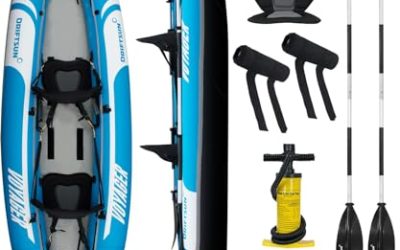
- Best for: Solo paddlers without a roof rack or garage space who still want to bring a second person along sometimes.
- Inflated dimensions: 151 x 37 x 18 in
- Maximum capacity: 400 lb, 2 person
- SuperTough PVC construction
- Adjustable, removable bucket seats with backrests
Solo paddlers without a roof rack or garage space who still want to bring a second person along sometimes.
It must be dried fully before storage, and inflation adds setup minutes that hard shells do not need.
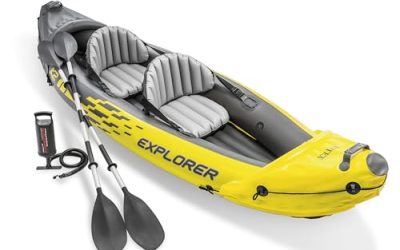
The Excursion Pro K2 solves a different problem: the tandem that has to live in a closet and travel in a trunk. Its inflatable seats are removable and repositionable, so one paddler can sit aft-center with the second seat left out entirely, and the whole set — two 86-inch paddles, a high-output pump, detachable rod holders — packs into the included carry bag. The SuperTough PVC hull and removable skegs make it a legitimate fishing and lake boat rather than a pool toy. Just respect the arithmetic: 400 lb is the lowest ceiling here, so a heavier paddler plus camping gear will use most of it.
Which One Fits Your Situation
Your partner paddles some weekends, not most
Choose the Tribe 13.5. The molded center seat means solo trim is a designed mode rather than a workaround, and switching back to two framed seats takes minutes at the launch. Its 500 lb ceiling covers most couples plus a picnic load, and the lighter hull keeps solo car-topping realistic week after week.
You fish alone but host a kid or dog on Sundays
The BKC Brooklyn 12.5 Tandem earns its keep here. Solo, you get the adjustable seat, standing deck, and six rod holders; crewed, the same hull seats two to three with capacity to spare. If fishing is only occasional, the Rambler’s cleaner recreational deck may suit you better, but for rod-first use the BKC is the honest match.
You have a sedan, a closet, and no roof rack
Take the Excursion Pro K2. It deflates into its carry bag, rides in the trunk, and still gives you a two-person boat with paddles and pump in the box. You trade glide and puncture toughness for that convenience, and you must dry it before it goes back in the closet, but no hard shell on this page fits your storage reality at all.
You are a heavier paddler who camps from the kayak
Look at the Rambler 13.5 first. Its 550 lb rating leaves the most headroom once your weight, a tent, and food are aboard, and the big rear well is shaped for exactly that load. The catch is the deck-loop homework for solo trim and a 78 lb hull, so confirm your launch routine can handle both before ordering.
Common Mistakes
- Paddling a tandem from the rear seat with no center option, then blaming the kayak for poor tracking in wind.
- Reading the capacity figure as a solo guarantee and ignoring how concentrated weight changes trim.
- Forgetting that paddles, PFDs, and scupper plugs are not always in the box; check the listing bundle before the first trip.
- Buying a 13-foot hard shell with no plan for loading it alone — no cart, no rack pads, no practice lift.
- Storing an inflatable damp in its bag, which invites mildew and shortens the material’s life.
Frequently Asked Questions
Can one person really paddle a tandem kayak comfortably?
Yes, provided the hull offers a seat position near its center. Sitting mid-boat keeps the trim level, so the kayak tracks straight and responds to strokes evenly. Paddling from the rear seat of a fixed two-seat tandem lifts the bow, catches wind, and forces constant correction strokes, which is why every pick above has a stated solo arrangement.
Is a tandem paddled solo slower than a solo kayak?
Usually a little, yes. A tandem hull is longer and wider than a comparable solo boat, so it carries more surface drag and takes more effort to turn. The length does help it hold a straight line and glide between strokes on open water. For recreational distances and fishing, most paddlers find the difference acceptable given the second seat waiting at home.
What should I check before ordering a tandem for solo use?
Confirm the solo seating method in the listing itself — a molded center seat, movable seat, or a documented deck-loop conversion. Then check hull weight against your solo loading routine, capacity against your real load with margin, and what the bundle includes, since paddles and accessories are not guaranteed. Finally, measure your storage space against the listed dimensions.
Are inflatable tandems safe for solo paddling?
A well-made inflatable with separate air chambers is a sound solo platform on lakes and slow rivers, and its wide, soft hull feels stable to beginners. The Excursion Pro K2’s removable seats let you sit in a balanced position alone. Keep to the stated capacity, inflate to the specified pressure, and avoid sharp rock gardens where a hard shell would shrug off contact.
FAQ
Can one person really paddle a tandem kayak comfortably?
Is a tandem paddled solo slower than a solo kayak?
What should I check before ordering a tandem for solo use?
Are inflatable tandems safe for solo paddling?
More from Amazon
Programs that pair well with the guide above. Offers and eligibility are set by Amazon and may change.
Free shipping on eligible items, Prime Video and more. Eligible new members can start with a free trial.
Start a Prime free trialAudiobooks and podcasts to listen to on the go. Eligible new members can start with a free trial.
Try Audible freeAd-free music streaming. Eligible new subscribers can start with a free trial.
Try Music Unlimited freeA free business account with business pricing and bulk-buying tools for work, shop or home office.
Create a business accountAs an Amazon Associate we earn from qualifying purchases.
Write Your Review
No reviews yet. Be the first to share your experience!