
Key takeaways
- Compare outdoor rated beverage refrigerators with adjustable shelves by capacity, temperature range and build as listed, for patios See which models earn.
A beverage refrigerator that lives outside has a harder job than one in a kitchen. It has to hold its temperature through hot afternoons, shrug off humidity and splashes, and keep working in a garage, on a patio or inside an outdoor kitchen island where an indoor cooler was never designed to go. The second half of the brief matters just as much: adjustable shelves. Cans, stubby bottles, tall bottles and mixers all stand at different heights, and fixed shelving wastes the space between them. This guide compares outdoor beverage refrigerators whose listings state both halves of that brief — approval for outdoor use and shelving you can move — using the capacities, temperature ranges and shelf details stated in each Amazon listing.
As an Amazon Associate we earn from qualifying purchases.
Quick Picks
| Model | Capacity | Temperature range | Shelving | Best fit |
|---|---|---|---|---|
| Whynter BOR-53024-SSWa | 5.3 cu ft, up to 175 cans | 32°F to 64°F | 3 removable and adjustable wire shelves | Built-in outdoor bars that also chill bottles |
| Bull 13700 Series II | 4.9 cu ft | 32°F to 50°F | 3 wire shelves, 2 adjustable | Outdoor kitchen islands with front venting |
| HCK K168 | 6.04 cu ft, up to 161 cans as a fridge | 32°F to 50°F | 3 removable, fully adjustable shelves | Hosts who want draft taps and can storage in one unit |
The Whynter is the straightforward beverage pick of the three: the widest temperature range, the largest stated can count and a lock, in a 24-inch frame that builds in or stands alone. The Bull is the island specialist, with front venting and fans on both sides of the cabinet wall so it can sit inside a closed outdoor kitchen. The HCK is the convertible: it arrives as a three-tap kegerator and converts to a shelved beverage refrigerator when the keg comes out, so it only belongs here if that second role is one you will genuinely use.
How to Choose
Start with the outdoor approval, not the finish. Stainless steel on the door does not make a refrigerator an outdoor appliance. What counts is that the maker states the unit is built and certified for outdoor use, with the electrical safety listing to back it up. An indoor beverage cooler moved onto a patio runs its compressor far harder in summer heat, sweats in humidity and puts household electrics in a wet location. Every model in this guide states outdoor use in its own listing, and that statement — not the styling — is the first thing to check on any model you add to the shortlist.
Check the shelving claim shelf by shelf. Adjustable can mean several different things: shelves that slide between fixed support slots, shelves that lift out entirely, or a mix of both. Count how many shelves actually move. A unit with three shelves where only two adjust still gives you one tall zone and one fixed zone, which may be exactly right for a bottom row of tall bottles under two rows of cans. Removable shelves matter too, because a shelf that comes out lets you stand wine bottles, growlers or a drinks dispenser upright instead of laying them down.
Match capacity to how you actually stock. Can counts in listings assume standard 12 oz cans packed tightly. Bottles take more room, and a shelf set for tall bottles can cut the working capacity well below the headline figure. As a rough guide from the listings here, a 24-inch outdoor unit holds somewhere between 160 and 175 cans when shelved for cans. If your mix leans toward bottles, shop by cubic feet and shelf spacing rather than the can number, and keep one shelf position free for tall items.
Look at the temperature range at both ends. A low end near 32°F keeps soft drinks and beer properly cold even when the cabinet sits in a warm spot. The high end matters if you also store wine or anything you do not want near freezing: a range that runs into the low 60s covers that without a second appliance. Also check the stated ambient limit where one is given — a unit approved for outdoor use in ambient heat up to a stated figure is telling you the conditions its compressor was built for.
Decide built-in or freestanding before you measure. Built-in units vent at the front, through the grille below the door, so they can sit inside an island or under a counter with no clearance at the sides. Freestanding units vent at the back or sides and need air space around them. Measure the cutout, not just the space the box will occupy: listings state cutout dimensions for built-in models, and the door swing, handle depth and any casters all add to the working footprint.
Plan the door and the lock. A reversible door lets the unit fit either end of an island run. A lock sounds minor until the refrigerator sits in an open patio, a pool area or a rental property; two of the three models here include one. Interior lighting and a digital readout are worth having outdoors, where you are often opening the door at dusk with your hands full.
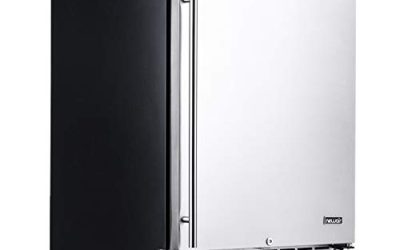
Whynter BOR-53024-SSWa 24-Inch Built-In Outdoor Beverage Refrigerator

Whynter’s BOR-53024-SSWa is the most direct answer to the brief in this group. The listing states indoor and outdoor use, a full stainless steel body, and three wire shelves that are both removable and adjustable, so the interior can be set up for cans, bottles or a mix of the two. The stated capacity is 175 standard 12 oz cans in 5.3 cubic feet, the largest can count here, and the temperature range runs from 32°F up to 64°F — wide enough to keep drinks at serving cold at one end and hold bottles you do not want chilled hard at the other.
Cooling is by a fan-circulated compressor system, which suits outdoor duty because the fan keeps the cabinet even when the door is opened often during a gathering. The unit installs built-in or freestanding, and Whynter offers optional caster wheels with locks if you want it mobile; note that the casters raise the height, which matters under a counter. A cylinder lock with two keys secures the door, the door swing is reversible, and soft interior lighting helps when you are loading it in the evening.
Specs
- Capacity: 5.3 cu ft, up to 175 standard 12 oz cans
- Temperature range: 32°F to 64°F
- Shelving: 3 removable and adjustable wire shelves
- Installation: built-in or freestanding, front venting
- Construction: full stainless steel body with curved handlebar
- Cooling: fan-circulated compressor cooling
- Security: cylinder lock with two keys; reversible door swing
- Dimensions: 34 in H x 24 in W x 24 in D (36.5 in H with casters fitted)
- Power: 115V / 60Hz, 160W, 1.8A; ETL certified
- Net weight: 92 lbs
Best for: Outdoor bars and patio kitchens that need one 24-inch unit to handle cans and bottles, with a lock for an open or shared space.
Watch out for: The door is solid stainless rather than glass, so you open it to check stock. At 92 lbs it is a two-person lift, and the caster option adds height that can break an under-counter fit.
See the Whynter BOR-53024-SSWa on Amazon
Bull 13700 Series II Outdoor Refrigerator

Bull builds equipment for outdoor kitchens, and the 13700 Series II is its 24-inch refrigerator for that setting. The listing describes 304 stainless steel construction throughout, outdoor approval with ETL, DOE and CE certifications, and a full-range digital temperature control running from 32°F to 50°F with a readout on the front. Inside there are three wire shelves, two of them adjustable on shelf supports, so you can open up a tall zone for bottles while keeping the fixed shelf for cans.
The detail that sets the Bull apart for island builds is the venting: front venting with internal and external fans, which is what allows it to run built into a closed outdoor kitchen island as well as freestanding. The listing gives a cutout of 24 1/4 inches wide by 33 inches high by 23 5/8 inches deep for that kind of installation. The door locks and reverses, and Bull sells a separate finishing frame for a flush island look if you want the edges dressed.
Specs
- Capacity: 4.9 cu ft
- Temperature range: 32°F to 50°F, digital control with readout
- Shelving: 3 wire shelves, 2 of them adjustable
- Construction: 304 stainless steel throughout
- Venting: front venting with internal and external fans
- Installation: freestanding or built-in; cutout 24 1/4 in W x 33 in H x 23 5/8 in D
- Door: locking and reversible
- Certifications: ETL, DOE and CE, with outdoor use stated in the listing
Best for: Built-in outdoor kitchen islands, where front venting and a locking stainless door matter more than the last few cans of capacity.
Watch out for: Only two of the three shelves adjust, so the layout is less flexible than the Whynter’s. The temperature range tops out at 50°F, which is fine for drinks but leaves no warmer zone for bottles you prefer less cold.
See the Bull 13700 Series II on Amazon
HCK K168 Outdoor Kegerator and Beverage Refrigerator
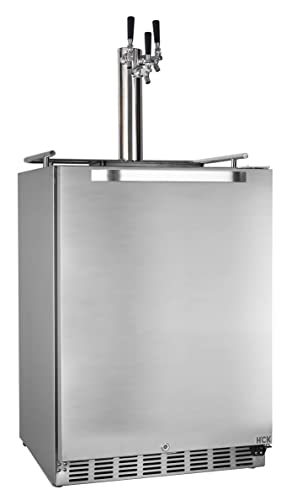
The HCK K168 earns its place here as the convertible. In its primary role it is a 24-inch outdoor kegerator with three taps, and the listing is explicit that the unit is built for outdoor use in ambient temperatures up to 108°F. Take the keg out and fit the shelves, and it works as a beverage refrigerator holding up to 161 standard cans in 6.04 cubic feet — the largest cabinet in this guide. Those shelves are three in number, removable and fully adjustable, and the stated temperature range for the cabinet is 32°F to 50°F.
For a host who genuinely alternates — draft for a party season, cans and bottles the rest of the year — that dual role replaces two appliances with one footprint. The door is stainless steel and reversible, defrost is automatic, and the unit can stand freestanding or slide under a counter in an outdoor kitchen or home bar. If you know you will never pour from a keg, though, the honest pick is one of the two dedicated refrigerators above: the tap hardware is capacity and complexity you will not use.
Specs
- Capacity: 6.04 cu ft; up to 161 standard cans in refrigerator mode
- Outdoor use: built for outdoor use in ambient heat up to 108°F, per the listing
- Temperature range: 32°F to 50°F
- Shelving: 3 removable, fully adjustable shelves for refrigerator mode
- Draft hardware: 3 taps in kegerator mode
- Door: reversible stainless steel door
- Defrost: automatic defrost
- Installation: freestanding or under-counter
Best for: Hosts who want one outdoor unit that pours draft beer for events and converts to shelved can and bottle storage the rest of the time.
Watch out for: It is a kegerator first, so the beverage refrigerator role is the conversion, not the main design. It is also the largest unit here, so check the space and the door swing before committing.
Which One Fits
For a dedicated drinks refrigerator in a 24-inch opening, the Whynter BOR-53024-SSWa is the default choice: the most cans, the widest temperature range, fully removable and adjustable shelving, and a lock, in a cabinet that builds in or stands alone. Choose the Bull 13700 Series II when the refrigerator is going into a finished outdoor kitchen island and the front-venting, fan-assisted design and all-stainless build are the priority, accepting a little less capacity and one fixed shelf. Choose the HCK K168 only when the draft taps are a feature you will use; as a convertible it is the biggest cabinet here, but its beverage mode is a second role rather than its main one.
Common Mistakes
Putting an indoor cooler outside. The most common error is also the most avoidable. An indoor beverage refrigerator on a patio has no outdoor approval, works its compressor far beyond its design brief in summer, and places household electrics in a damp location. Check that outdoor use is stated by the maker, not implied by a stainless door.
Trusting the can count with a bottle habit. Headline capacities assume cans. If most of what you chill stands tall, set one shelf zone aside for bottles and expect the working total to drop well below the stated figure.
Ignoring the venting direction. A rear-venting unit sealed into an island will overheat and short-cycle. If the refrigerator is going inside cabinetry, front venting is a requirement, not a preference — and never block the front grille once it is installed.
Forgetting the extras that change the fit. Casters add height, handles add depth, and a door needs swing room. Measure with those fitted, using the cutout dimensions in the listing, before the unit arrives.
Skipping the lock on an open patio. A refrigerator that sits outside a locked building, near a pool or at a rental property should lock. It is a small feature that is difficult to add later.
FAQ
Can an indoor beverage cooler be used outside if the patio is covered?
A roof helps with rain but not with heat or humidity, and coverage does not change what the appliance was built and certified for. The models in this guide state outdoor use in their listings; an indoor cooler carries no such statement, so its compressor duty, insulation and electrics are all specified for indoor conditions. If the refrigerator will live outside, choose one whose maker states outdoor use.
What should I check to confirm a refrigerator is genuinely built for outdoor use?
Look for three things in the listing: an explicit statement of outdoor use from the maker, a recognised electrical safety certification such as ETL, and construction suited to the setting, such as a stainless steel body. Where a maker states an ambient temperature limit for outdoor operation, as HCK does with its figure of 108°F, that is a further sign the unit was specified for outdoor conditions rather than simply finished to look the part.
How many cans does a 24-inch outdoor beverage refrigerator hold?
It depends on the model and on how the shelves are set. The listings in this guide state up to 175 standard 12 oz cans for the 5.3 cu ft Whynter and up to 161 cans for the HCK in refrigerator mode. Those figures assume cans throughout; mixing in bottles, especially tall ones, reduces the real total, which is why adjustable shelving matters.
Do adjustable shelves matter for bottles as well as cans?
Yes — bottles are where they matter most. Cans stack at a fairly uniform height, but bottles vary from short stubbies to tall wine and mixer bottles. Shelves that move between support positions, or lift out entirely, let you create one tall zone and keep the remaining shelves at can height, instead of wasting the headroom above every row.
Conclusion
An outdoor beverage refrigerator earns its place by doing two things an indoor cooler cannot: holding temperature outside through summer heat with the maker’s outdoor approval behind it, and reshaping its interior around what you actually drink. The Whynter BOR-53024-SSWa covers both points most completely for a standard 24-inch opening. The Bull 13700 Series II is the island builder’s pick, with front venting and fans made for enclosed cabinetry. The HCK K168 is the specialist convertible for hosts who will use its taps. Match the venting to your installation, set one shelf zone aside for tall bottles, and any of the three will serve a patio far better than an indoor unit pressed into outdoor duty.
FAQ
Can an indoor beverage cooler be used outside if the patio is covered?
What should I check to confirm a refrigerator is genuinely built for outdoor use?
How many cans does a 24-inch outdoor beverage refrigerator hold?
Do adjustable shelves matter for bottles as well as cans?
More from Amazon
Programs that pair well with the guide above. Offers and eligibility are set by Amazon and may change.
Free shipping on eligible items, Prime Video and more. Eligible new members can start with a free trial.
Start a Prime free trialAudiobooks and podcasts to listen to on the go. Eligible new members can start with a free trial.
Try Audible freeAd-free music streaming. Eligible new subscribers can start with a free trial.
Try Music Unlimited freeA free business account with business pricing and bulk-buying tools for work, shop or home office.
Create a business accountAs an Amazon Associate we earn from qualifying purchases.
Write Your Review
No reviews yet. Be the first to share your experience!