
Key takeaways
- Lithium vs lead-acid jump starters for winter: weight, cold behaviour, storage drain, cranking delivery and care, with three representative models.
Both chemistries promise the rescue: a dead battery, a cold morning, an engine that turns over anyway. What changes with the chemistry is everything around that moment — what you carry, how it behaves after months in a freezing trunk, and how much upkeep it demands. Lead-acid booster packs are the older workshop tool: heavy, simple, built around a replaceable battery. Lithium packs are the glove-box generation: a fraction of the weight, sealed, doubling as device chargers. In winter, those differences decide whether the rescue works.
This comparison is for drivers choosing their first pack, households deciding what stays in the car, and anyone whose garage rescues neighbours. It uses three representative models whose listings state the key figures: the NOCO Boost GB40 and GOOLOO GP4000 on the lithium side, and the Clore Jump-N-Carry JNC770R carrying the lead-acid case. Every specification below comes from those listings — including the gaps, where a listing states no temperature range or certification at all.
Quick Picks
As an Amazon Associate we earn from qualifying purchases.
| Product | Best for | Key spec from title |
|---|---|---|
| NOCO Boost GB40 | Most car owners who want a glove-box pack | 1000A lithium at 2.4 lb; up to 20 starts per charge |
| GOOLOO GP4000 | Large gas engines and diesels up to 10.0L | 4000A lithium; operating range stated as -4°F to 140°F |
| Clore Jump-N-Carry JNC770R | Garages and repeated jumps, day after day | 1700 peak / 425 cranking amps; 22 Ah AGM; 68-inch cables |
What Actually Differs
Size and weight you actually carry
This is the difference you feel first. The GB40 weighs 2.4 lb and the GP4000 3.9 lb; the JNC770R weighs 23 lb, roughly ten GB40s. A lithium pack lives in a glove box, a door pocket or under a seat, so it is in the car when the battery dies at a trailhead or a ski lodge. The Clore lives on a garage shelf or a workshop bench, carried out when needed. Neither is wrong — but a 23 lb pack that stays home has never started a car in a supermarket car park, and that simple fact decides many purchases.
Cold-weather behaviour and self-discharge in storage
Lithium packs hold their charge in storage far longer than lead-acid ones, which steadily self-discharge and sulfate if left low — a lead-acid pack wants a charger habit, not a drawer. Cold cuts both ways: a lithium pack delivers less when cold-soaked, and of these three listings only the GP4000 states an operating range, down to -4°F. The GB40 states none. The Clore states no numeric range either, though its listing does say the 68-inch cables remain flexible in extreme temperatures, which matters when you are wrestling stiff leads at dawn. Any pack, kept charged and stored in the cabin, starts winter ahead.
Cranking delivery and the extras around it
The headline numbers are not directly comparable across chemistries. The Clore lists both 1700 peak amps and 425 cranking amps — the cranking figure is the sustained delivery a cold engine actually draws on — while the lithium listings lead with peak figures of 1000A and 4000A. Cable reach differs just as much: the JNC770R’s 68-inch leads reach awkward batteries and let you stand clear, where lithium clamps are short and the pack dangles near the engine. Extras have converged, though: all three offer USB charging, and the Clore adds a 12V accessory outlet, while the lithium packs double as genuine power banks for phones and, with the GP4000, 12V accessories via an included adapter.
Lifespan, care and replacement
A lead-acid pack is a maintained tool. The JNC770R’s AGM battery is replaceable when it eventually fades, and its built-in automatic 3A charger exists because the chemistry punishes neglect: leave it discharged through a winter and the battery itself is the casualty. Lithium packs are sealed appliances — nothing to top up, nothing user-replaceable, and when the cells age out the whole unit is done. Their care list is shorter but not empty: check the charge every few months, keep the pack out of extreme heat, and never keep using a unit whose case is swollen or damaged.
The Representative Models
NOCO Boost GB40

The GB40 is the lithium case in miniature: 1000A, rated for gas engines up to 6.0 litres and diesels up to 3.0 litres, light enough to forget in a glove box until the morning it matters. Its listing states spark-proof and reverse-polarity protection, an IP65-rated enclosure, and UL under Specification Met — the only certification named among these three listings. It claims up to 20 starts per charge and recharges in about three hours. Its honest limit is cold data: the listing states no operating temperature, so its winter case rests on staying charged and stored sensibly, not on a stated figure.
Specs
- Chemistry: lithium
- Peak amps: 1000A
- Engine fit: up to 6.0L gas / 3.0L diesel
- Starts per charge: up to 20; recharge about 3 hours
- Battery capacity: 2150 mAh; weight 2.4 lb
- Flashlight: 100-lumen LED, 7 modes including SOS and strobe
- Safety as stated: spark-proof technology, reverse polarity protection, IP65-rated enclosure
- Certification as stated: UL (Specification Met, listing spec field)
- Operating temperature: not stated in the listing
Best for: A single-car household that wants one small pack living in the car year-round.
Watch out for: No operating temperature is stated, and 1000A is car-sized output — it is not the tool for a large diesel.
ASIN: B015TKUPIC
GOOLOO GP4000

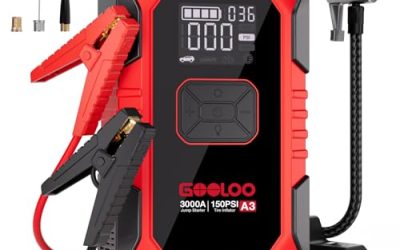
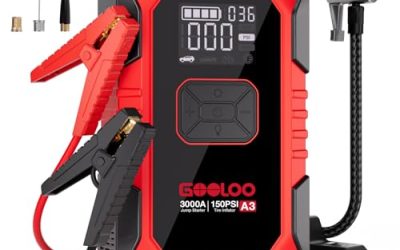
The GP4000 answers the usual objection to lithium — that it is a fair-weather gadget — with the strongest listing data here: 4000A, rated for all gas engines and diesels up to 10.0 litres, and an operating range stated in the listing from -4°F to 140°F. At 3.9 lb it remains a one-hand carry, and its BOOST button addresses batteries too low for a standard smart-clamp start. Dual USB outputs, a USB-C port and an included cigarette lighter adapter make it a real power bank as well. What the listing does not state is any certification, so its case rests on specifications rather than seals.
Specs
- Chemistry: lithium
- Peak amps: 4000A
- Engine fit: all gas engines; diesel up to 10.0L
- Battery capacity: 24,000 mAh; weight 3.9 lb
- Operating temperature stated in listing: -4°F to 140°F
- Outputs: dual USB (one quick-charge), USB Type-C 5V/3A, cigarette lighter socket adapter included
- BOOST force-start button; smart jumper cable with 10 types of built-in protection stated
- Certification: not stated in the listing; wall charger not included
Best for: Trucks, big SUVs and diesels that must start outdoors in serious cold.
Watch out for: Plan on charging it from a vehicle or existing USB supply, since no wall charger is in the box per the listing data.
ASIN: B09HJH1S41
Clore Jump-N-Carry JNC770R

The JNC770R is the lead-acid argument made metal: a 22 Ah AGM battery delivering 1700 peak amps and 425 cranking amps, with 68-inch heavy-gauge cables that the listing says stay flexible in extreme temperatures, finished with PowerJaw clamps and a master on/off switch. At 23 lb it is a garage instrument, not a glove-box one, and its built-in automatic 3A charger reflects a chemistry that must be kept fed. The payoffs are sustained cranking, reach, a replaceable battery when the years catch up, and a 12V accessory outlet alongside dual USB ports. The listing names no certification and states no built-in light.
Specs
- Chemistry: lead-acid AGM (PROFORMER battery, replaceable per brand copy)
- Peak amps: 1700A; cranking amps: 425A
- Battery capacity: 22 Ah; weight 23 lb
- Cables: 68-inch heavy-gauge, stated to remain flexible in extreme temperatures; PowerJaw clamps; master ON/OFF switch
- Outputs: dual USB (1.1A and 2.1A) plus 12V accessory power supply
- Charging: built-in automatic 3A charging system, cord included
- Flashlight: not stated in the listing
- Certification and numeric operating range: not stated in the listing
Best for: A home garage, smallholding or workshop that jump-starts vehicles regularly.
Watch out for: It only earns its keep if it stays charged — a lead-acid pack left flat through winter can damage its own battery — and 23 lb will not live in most cars.
ASIN: B01GQDBNWS
Safety First: Jump Starting and Charging Without the Drama
Whichever chemistry you choose, the connection ritual is the same. Red clamp to the dead battery’s positive terminal first, black clamp to an unpainted metal ground on the engine or chassis, well away from the battery; remove them in reverse order. Work spark-aware: no smoking, no loose metal tools resting on terminals, and on the JNC770R use its master switch so the clamps are dead until you are ready. Never jump a battery that is frozen, cracked, swollen or leaking — replace it instead. Charge lead-acid packs somewhere ventilated, since charging can vent gas, and keep a charged lead-acid pack topped up rather than stored flat. Lithium packs ask for the opposite discipline: out of extreme heat, off the summer dashboard, and checked every few months.
Which One Fits Your Situation
One car, one glove box, minimal fuss
Choose lithium, and specifically the GB40. It weighs 2.4 lb, states spark-proof and reverse-polarity protection, and asks only for a charge check every few months. A lead-acid pack would spend its life in your garage, which is precisely where it is not needed when the battery dies at work. For a single everyday car, portability beats the Clore’s sustained cranking and cable reach.
A truck or diesel that must start at the cabin or the job site
The GP4000 is the lithium exception that suits remote winter use: rated for diesels up to 10.0 litres and the only model here whose listing states a cold operating range, down to -4°F. It still weighs under 4 lb, so it can ride in the truck permanently. The Clore’s cranking stamina is tempting, but 23 lb of garage equipment does not help a truck parked a mile from the nearest building.
A garage that rescues the whole street
This is the JNC770R’s home ground. Repeated jumps in a day, batteries in awkward engine bays reached by 68-inch cables, a battery you can replace instead of replacing the whole unit — lead-acid’s maintenance burden stops mattering when the pack lives beside its own built-in charger. Keep it plugged in or charge it after every use and it will outlast several lithium packs in this role.
You forget about gear for months at a time
Be honest about the maintenance you will actually do. A lithium pack tolerates forgetfulness better, holding its charge far longer in storage, though it still needs a check a few times a year. A lead-acid pack left discharged in a cold garage can be ruined by that same neglect. If nobody in the household will maintain a charger routine, lithium is not just the lighter choice — it is the one that will still work.
Common Mistakes
- Comparing peak amps across chemistries as if the numbers were measured the same way, when the lead-acid listing’s cranking-amp figure describes a different, sustained delivery.
- Leaving a lead-acid pack discharged in the garage all winter, then finding the battery inside it has been damaged by the neglect.
- Assuming a lithium pack needs no attention at all and never checking its charge between one winter and the next.
- Buying a heavy workshop pack for a car that parks away from home, where the pack will never be when the battery fails.
- Attempting to jump a frozen or leaking battery with either chemistry instead of replacing the battery first.
Frequently Asked Questions
Which type holds its charge longer in a stored car?
Lithium, by a wide margin. Lead-acid packs self-discharge and their batteries suffer if left low, which is why the JNC770R ships with a built-in charger and expects a charging routine. A lithium pack self-discharges slowly, so check it every few months — but it tolerates the glove-box life that would ruin an untended lead-acid unit over a couple of seasons.
Is the lead-acid pack stronger because it lists cranking amps?
Not stronger — more completely specified. Cranking amps describe sustained delivery, the figure a cold engine actually draws against, while lithium listings headline a brief peak. The JNC770R’s 425 cranking amps against 1700 peak shows how far apart the two numbers sit on one product. Judge each pack by the engine size its listing states and by your vehicle, not by whichever number is printed largest.
Can I leave either type in the car through summer?
The lead-acid pack tolerates heat better but still ages faster hot, and it is too heavy to live in the car. Lithium packs should be kept out of extreme heat: a sun-baked cabin shortens their life, and a swollen or damaged lithium pack should be retired, not used. For either chemistry, a shaded spot in the cabin beats a hot trunk, and winter storage habits matter less than summer ones.
When the battery inside eventually dies, can it be replaced?
On the JNC770R, yes — its AGM battery is replaceable per the brand copy, which is a genuine long-term advantage for a workshop tool. The lithium packs here are sealed units; when their cells fade, the whole pack is replaced. That tilts the lifetime maths toward lead-acid for stationary use, and toward lithium anywhere the pack has to travel with the car.
FAQ
Which type holds its charge longer in a stored car?
Is the lead-acid pack stronger because it lists cranking amps?
Can I leave either type in the car through summer?
When the battery inside eventually dies, can it be replaced?
More from Amazon
Programs that pair well with the guide above. Offers and eligibility are set by Amazon and may change.
Free shipping on eligible items, Prime Video and more. Eligible new members can start with a free trial.
Start a Prime free trialAudiobooks and podcasts to listen to on the go. Eligible new members can start with a free trial.
Try Audible freeAd-free music streaming. Eligible new subscribers can start with a free trial.
Try Music Unlimited freeA free business account with business pricing and bulk-buying tools for work, shop or home office.
Create a business accountAs an Amazon Associate we earn from qualifying purchases.





Write Your Review
No reviews yet. Be the first to share your experience!