
Key takeaways
- Compare the best bee houses for mason and leafcutter bees, from replaceable cedar tubes to a wax-coated hotel, with sizes, materials and mounting notes.
A bee house gives solitary bees somewhere safe to nest in your garden. Mason bees, leafcutter bees and their relatives do not live in colonies or make honey. Each female looks for a hollow tube or a hole in wood, lays her eggs inside with a store of pollen, and seals the entrance. A well-made house copies that natural shelter, and in return the bees pollinate fruit trees, berries and vegetables as they work the flowers nearby.
The five houses below cover the main designs worth considering: a cedar house with replaceable paper tubes, a wax-coated hexagon built around the tube size mason bees prefer, a compact painted house with mixed bamboo tubes, a bamboo tube house in certified pine, and a lightweight tube bundle with the largest cell count here. They differ in tube material, how you clean them at the end of the season, and how they mount, so read the specs before you choose.
As an Amazon Associate, we earn from qualifying purchases.
Quick Answer
For most gardeners, the WHITEHORSE Premium Cedar Bee House is the strongest pick: western cedar construction, six-inch replaceable paper tubes and a French cleat mount make it the easiest house here to maintain year after year. If you want a house that arrives assembled with tubes already sized for mason bees, choose the POLLIBEE Wax-Coated Mason Bee House. On a small wall or balcony, the compact Nature’s Way PWH1-C is the simplest fit, while the Cestari house suits gardeners who prefer bamboo tubes in a certified pine frame. The Kinsman Giant Solitary Bee Nester is the budget-friendly capacity pick, packing 68 tubes into a bundle that weighs only a few ounces.
How to Choose a Bee House
Start with the tubes. Mason bees favour nesting tubes about 5/16 inch across and a full 6 inches deep, because the depth lets a female lay the balance of female and male eggs she plans for. Shorter or wider tubes still attract smaller solitary species, so a house with varied tube sizes hosts a wider mix of bees, while a house with one uniform size is the focused choice for mason bees.
Next, think about cleaning. Nesting tubes collect mites and parasites over a season, so the healthiest houses let you remove and replace paper tubes, or open the nesting block, once the cocoons are harvested. Fixed bamboo tubes cannot be opened, which makes those houses simpler but effectively disposable after a season or two.
Finally, plan the mounting. A bee house belongs on a sunny wall, fence or post, facing south or east to catch morning warmth, roughly three to six feet off the ground and sheltered from driving rain. A solid roof overhang and a firm fixing matter more than decoration, because a house that swings in the wind or fills with rainwater will be ignored.
WHITEHORSE Premium Cedar Bee House

The WHITEHORSE house is built the way mason bee keepers recommend. The body is western cedar joined with screws rather than nails, with a thicker roof and a large overhang that shades the tube entrances, plus a half-inch gap in front of the tubes for extra rain protection. Dado joints at the back keep the box dry and reduce drafts around the nesting chambers.
Its six-inch paper tubes are replaceable, which is the feature that matters most over time. At the end of the season you can pull the filled tubes, harvest the cocoons and slide in fresh tubes, instead of throwing the whole house away. Mounting is part of the design: a French cleat and the included hardware fix it flat and firm against a wall or post.
Specs
- Model: BEH-P
- Material: Western cedar wood
- Nesting tubes: Paper tubes, 6 in long, replaceable, included
- Dimensions: 5.25 x 8.75 x 5.75 in
- Weight: 950 g
- Mounting: French cleat, mounting hardware included
- Warranty: 1 year limited
Who it’s for / who should skip
This house suits gardeners who plan to keep mason bees for several seasons and want the cleaning and tube renewal handled by design. Skip it if you need a ground stake for a flower bed, because the French cleat needs a flat wall or post, or if you want a multi-insect hotel with separate compartments for butterflies and ladybirds.
POLLIBEE Wax-Coated Mason Bee House
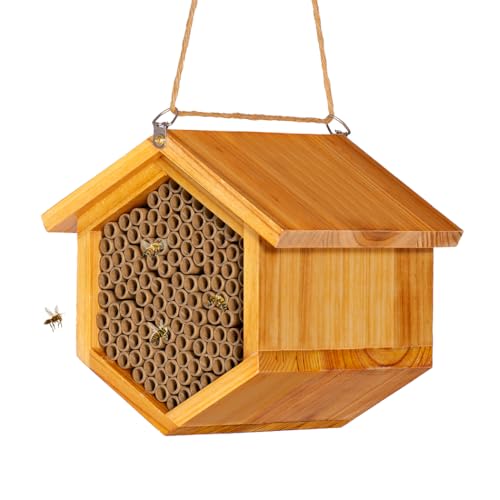
POLLIBEE coats the whole wooden body of this hexagon house in wax, which the maker uses to extend its service life outdoors. It arrives fully assembled, and the nesting tubes get the key dimensions right: every kraft paper tube is 5/16 inch in diameter and 6 inches long, the size mason bees prefer, and the tubes slide out so cocoons can be removed for winter storage.
Hanging options are generous. A stainless steel screw clasp on the back fixes the house to a tree or wall, and a one-metre rope, hooks and nails are included for other spots. At just over seven inches wide it has a compact footprint for a fence panel or orchard post.
Specs
- Material: Wood with full wax coating, species not stated
- Nesting tubes: Kraft paper, 5/16 in diameter x 6 in long, removable
- Tube count: Not stated
- Dimensions: 7.56 x 7.2 x 6.77 in
- Weight: 1.31 kg
- Mounting: Rear screw clasp, 1 m rope, hooks and nails included
- Assembly: None, arrives assembled
Who it’s for / who should skip
Choose this house if you want an assembled, weather-coated home whose tubes are already sized for mason bees, with cocoon access for routine maintenance. Skip it if you want a range of tube diameters for several solitary species, because every tube here is the same mason-bee size, or if the listing’s missing tube count matters to you.
Nature’s Way PWH1-C Teal Bee House

Nature’s Way is an established bird-products brand, and the PWH1-C is its compact pollinator house. The slim teal body mixes two kinds of nesting space: hollow bamboo tubes in differing diameters and pre-drilled wood blocks, so it can host mason bees, leafcutter bees and other solitary species of different sizes in one small house.
It is the smallest and lightest pick here, at eight inches tall and under a pound and a half, and it comes with an easy-mount hanger already fitted. That makes it a practical first bee house for a balcony, a small yard or a sheltered fence panel where a larger cedar house would crowd the space.
Specs
- Model: PWH1-C
- Dimensions: 8 x 6 x 3.5 in
- Weight: 1.41 lb
- Nesting space: Hollow bamboo tubes in varied diameters, pre-drilled wood blocks
- Tube count: Not stated
- Body material: Not stated
- Mounting: Easy-mount hanger, pre-installed
- Target species: Mason bees, leafcutter bees and other solitary bees
Who it’s for / who should skip
This house suits beginners and small spaces: hang it in a sunny, sheltered spot and it is ready for the season. Skip it if you want to harvest cocoons or replace nesting material each year, because the bamboo tubes are fixed in place, or if you need a large nesting capacity for an orchard.
Cestari Mason Bee House Bamboo Tube Bee Hotel

The Cestari house packs roughly 75 bamboo tubes into a frame of FSC-certified pine. The tubes vary in diameter, which suits a range of solitary species rather than mason bees alone, and each tube is over four inches long. An overlapping roof shelters the tube entrances from wind and rain.
This listing is the Rose Pink finish; the same house is sold in other colours under separate listings. The maker rates the house for one to two seasons of outdoor use, which is honest for a bamboo design: bamboo tubes cannot be opened for cleaning, so the house is a simpler, shorter-lived option than the replaceable-tube designs above.
Specs
- Material: FSC-certified pine frame, bamboo tubes
- Nesting tubes: About 75 bamboo tubes, over 4 in long, varied diameters
- Dimensions: 8 x 7.5 x 5 in
- Colour: Rose Pink (this listing)
- Mounting: Hang on a wall, fence or tree, about 4 ft off the ground
- Service life: 1 to 2 seasons, per the maker
Who it’s for / who should skip
Pick the Cestari if you prefer natural bamboo nesting tubes and certified timber, and you are happy replacing the house every season or two. Skip it if you keep mason bees seriously and need full six-inch tubes you can open and clean, because these tubes are shorter and fixed.
Kinsman Giant Solitary Bee Nester

The Kinsman nester takes the opposite approach to a boxed house: it is a simple bundle of 68 nesting tubes with no plastic anywhere in its construction. The tubes provide up to 360 individual bee cells, the largest capacity in this guide, yet the whole nester weighs only 3.2 ounces, so it can hang almost anywhere.
Full instructions are included. The maker suggests fixing it in a sunny, sheltered place facing south or east, secured with a doubled rope or a drainage pipe clamp so it cannot swing. Because the tubes lift out individually, you can also move filled tubes to another garden.
Specs
- Model: KMB
- Nesting tubes: 68 tubes, up to 360 bee cells
- Dimensions: 6.5 x 3.5 x 3.5 in
- Weight: 3.2 oz
- Construction: No plastic
- Mounting: Rope or pipe clamp, not included
- Instructions: Included
Who it’s for / who should skip
This nester suits gardeners who want maximum nesting capacity for very little weight, or a first house for an allotment or school garden. Skip it if you want a solid roofed house that shrugs off exposed weather on its own, because the open bundle needs a sheltered position, or if you want mounting hardware in the box.
Frequently Asked Questions
Where should I hang a bee house?
Hang it on a wall, fence or post that faces south or east, so the tubes catch the morning sun and warm up early. Fix it firmly about three to six feet off the ground, under an eave or other shelter if you can, and near flowers and a patch of bare mud the bees can use to seal their nests. Once bees start using it, leave it in the same spot.
What size tubes do mason bees prefer?
Mason bees favour tubes about 5/16 inch in diameter and a full 6 inches deep. Shallower tubes change the balance of male and female eggs a female lays, and wider tubes suit larger species instead. Houses with varied tube sizes, like the Nature’s Way and Cestari picks, host a broader mix of solitary bees rather than mason bees alone.
Do I need to clean a bee house?
Yes, some upkeep keeps the bees healthy. With paper-tube houses, remove the filled tubes in autumn, harvest the cocoons for winter storage and fit fresh tubes in spring; that breaks the cycle of mites and parasites. Fixed bamboo tubes cannot be cleaned out, so plan to replace a bamboo house after a season or two of use.
Will a bee house attract wasps or stinging bees?
Honey bees will not move into a tube house, because they live in colonies and need a very different home. Some gentle solitary wasps may use a few tubes alongside the bees, which is normal and harmless. Solitary bees are not aggressive: males cannot sting at all, and females sting only if handled or trapped.
Final Verdict
For a house you can maintain for years, the WHITEHORSE Premium Cedar Bee House is the best buy here, thanks to its cedar build, deep replaceable tubes and proper wall fixing. The POLLIBEE Wax-Coated house is the closest alternative, arriving assembled with mason-bee-sized tubes and a weather-shedding wax coat. Choose the Nature’s Way PWH1-C for a small, light house that mixes bamboo tubes and drilled blocks, the Cestari for certified pine and bamboo in a colourful finish, and the Kinsman nester when capacity per ounce matters more than a roofed box. Any of the five will give solitary bees a nesting place; match the tube style to how much seasonal cleaning you are willing to do.
Product and ASIN Reference
| Product | ASIN |
|---|---|
| WHITEHORSE Premium Cedar Bee House | B09FX5HJL4 |
| POLLIBEE Wax-Coated Mason Bee House | B08CVSCQHD |
| Nature’s Way PWH1-C Teal Bee House | B07NWBR315 |
| Cestari Mason Bee House Bamboo Tube Bee Hotel | B01G2QLQU8 |
| Kinsman Giant Solitary Bee Nester | B005FW89MO |
FAQ
Where should I hang a bee house?
What size tubes do mason bees prefer?
Do I need to clean a bee house?
Will a bee house attract wasps or stinging bees?
More from Amazon
Programs that pair well with the guide above. Offers and eligibility are set by Amazon and may change.
Free shipping on eligible items, Prime Video and more. Eligible new members can start with a free trial.
Start a Prime free trialAudiobooks and podcasts to listen to on the go. Eligible new members can start with a free trial.
Try Audible freeAd-free music streaming. Eligible new subscribers can start with a free trial.
Try Music Unlimited freeA free business account with business pricing and bulk-buying tools for work, shop or home office.
Create a business accountAs an Amazon Associate we earn from qualifying purchases.







Write Your Review
No reviews yet. Be the first to share your experience!