
Key takeaways
- Compare the best telescopes for beginners, from easy alt-az refractors to equatorial reflectors, with specs on aperture, mounts and included eyepieces.
Long, dark winter nights are the best stargazing season of the year, and a first telescope is what turns a casual glance at the sky into a real hobby. The Moon’s craters, Jupiter’s cloud bands and moons, the rings of Saturn, and the soft glow of the Orion Nebula are all within reach of a modest beginner scope, provided you choose one with honest optics and a mount that does not fight you. The problem is that the beginner market is crowded with flimsy department-store scopes that promise huge magnification numbers and deliver shaky, dim views that kill interest fast.
The five telescopes below are the established starter models from Celestron, Orion, and Zhumell that avoid those traps. They cover the two classic designs, refractors and reflectors, on both simple alt-azimuth mounts and German equatorial mounts, plus a tabletop Dobsonian for anyone short on storage space. Every pick is a complete kit sold on Amazon US with the eyepieces and finder you need to start observing the same night it arrives.
As an Amazon Associate, we earn from qualifying purchases.
How to Choose a Beginner Telescope
Aperture is the specification that matters most. It is the diameter of the main lens or mirror, measured in millimeters, and it decides how much light the telescope gathers. More light means brighter views and fainter objects: a 70mm refractor shows the Moon, planets, and bright star clusters well, while a 130mm reflector pulls in dimmer galaxies and nebulae. Focal length, divided by aperture, gives the focal ratio; a fast f/4 or f/5 scope gives wide, bright views at low power, while a slow f/13 refractor is naturally suited to high-power lunar and planetary work.
The mount matters as much as the optics. An alt-azimuth mount moves up-down and left-right like a camera tripod, which is intuitive for a first night out. A German equatorial mount tilts one axis to match Earth’s rotation, so once it is roughly polar aligned you can track an object across the sky by turning a single slow-motion knob. That tracking convenience costs setup time and a steeper learning curve, so be honest about how much fiddling you will tolerate on a cold night.
Ignore advertised maximum magnification. A telescope’s useful ceiling is roughly twice its aperture in millimeters, and the eyepieces in the box rarely get near it. What you actually use is the magnification each eyepiece gives, which is the focal length divided by the eyepiece focal length. Two decent eyepieces, one around 20mm to 25mm for finding and framing targets and one around 10mm for closer looks, cover most beginner observing.
Finally, look at the finder and the focuser. A red dot finder that projects a dot onto a small glass window is far easier for a beginner than a tiny magnifying finderscope. A standard 1.25-inch rack-and-pinion focuser accepts the huge range of aftermarket eyepieces you may add later. Every scope below includes both a finder and at least two eyepieces, so there is nothing else you must buy to start.
Celestron AstroMaster 70AZ

The AstroMaster 70AZ is the classic first refractor: a 70mm lens at the front of a long tube, sitting on a simple alt-azimuth mount with a pan handle you push to follow your target. There is no polar alignment and no counterweight, so setup is little more than extending the tripod legs and attaching the tube. The long f/13 focal ratio is forgiving of inexpensive eyepieces and delivers crisp, high-contrast views of the Moon and planets, which is exactly what most first-time observers point at.
Specs
- Optical design: Achromatic refractor
- Aperture: 70mm
- Focal length: 900mm
- Focal ratio: f/13
- Mount: Alt-azimuth with pan handle and adjustable steel tripod
- Eyepieces included: 20mm (45x) and 10mm (90x)
- Finder: StarPointer red dot finderscope
- Diagonal: Erect image diagonal for correctly oriented views
- Highest useful magnification: 165x
Who it’s for: Complete beginners and families who want the simplest possible setup and plan to spend most of their time on the Moon, planets, and bright clusters.
Who should skip: Anyone hoping to hunt faint galaxies and nebulae; the 70mm aperture gathers limited light, and the manual mount does not track, so objects drift out of view at high power.
Celestron PowerSeeker 127EQ
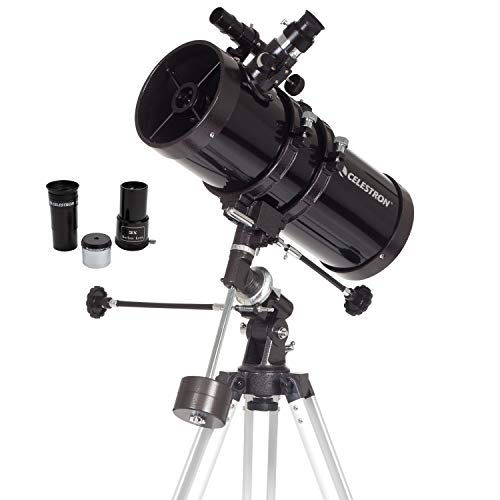
The PowerSeeker 127EQ puts a 127mm reflector on a German equatorial mount at an entry-level kit price, making it the cheapest route here to both a five-inch aperture and equatorial tracking. The design is a Bird-Jones reflector, which folds a long 1000mm focal length into a short, portable tube using a corrector lens in the focuser. Once the mount is polar aligned, a single slow-motion control keeps your target centered as Earth turns.
Specs
- Optical design: Bird-Jones Newtonian reflector
- Aperture: 127mm
- Focal length: 1000mm
- Focal ratio: f/8
- Mount: German equatorial with slow-motion controls and aluminum tripod
- Eyepieces included: 20mm (50x) and 4mm (250x)
- Barlow lens: 3x included
- Finder: 5×24 finderscope
- Highest useful magnification: 300x
Who it’s for: Beginners who want maximum aperture and an equatorial mount for the money and are willing to learn polar alignment and basic collimation.
Who should skip: Anyone who values sharp high-power views above all else; the 4mm eyepiece and 3x Barlow combine for more magnification than the optics can usefully deliver, and the Bird-Jones design is fussier to collimate than a standard Newtonian.
Orion StarBlast II 4.5 EQ
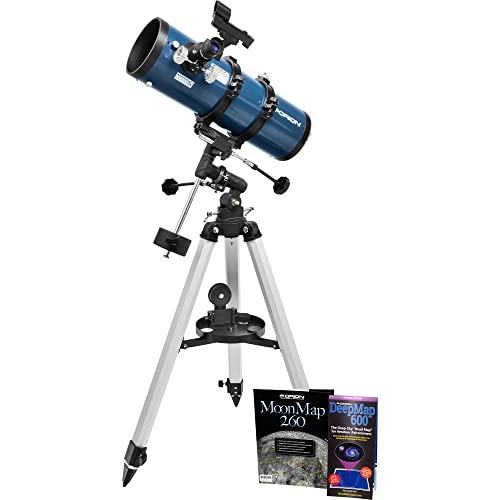
Orion’s StarBlast II 4.5 EQ pairs a compact 114mm Newtonian tube with a fast f/4 focal ratio, which produces wide, bright fields that are excellent for sweeping star clusters, the Orion Nebula, and the Andromeda Galaxy. The parabolic primary mirror is a genuine step up from the spherical mirrors in many budget reflectors, and the EQ-1 equatorial mount adds slow-motion tracking in a package that stays small enough to carry outside in one trip.
Specs
- Optical design: Newtonian reflector with parabolic primary mirror
- Aperture: 114mm (4.5 inches)
- Focal length: 450mm
- Focal ratio: f/4
- Mount: EQ-1 German equatorial with slow-motion controls
- Eyepieces included: 25mm (18x) and 10mm (45x) Sirius Plössl
- Finder: EZ Finder II reflex sight
- Focuser: 1.25-inch rack-and-pinion
- Highest useful magnification: 228x
Who it’s for: Beginners who care most about deep-sky objects and wide-field views, and grab-and-go observers who want a reflector that sets up fast and stores in a closet.
Who should skip: Planet specialists; the short focal length means you will want a Barlow lens or a short eyepiece, neither included, to reach high planetary magnifications.
Celestron AstroMaster 130EQ

The AstroMaster 130EQ is the step-up pick: a true 130mm Newtonian reflector with a 650mm focal length on Celestron’s CG-3 German equatorial mount. That aperture gathers enough light for hundreds of deep-sky objects while the f/5 ratio keeps the tube short and the views bright. Two slow-motion knobs let you track objects smoothly in both axes, and the included 20mm eyepiece has a built-in erect image corrector, so it doubles for terrestrial viewing.
Specs
- Optical design: Newtonian reflector
- Aperture: 130mm
- Focal length: 650mm
- Focal ratio: f/5
- Mount: CG-3 German equatorial with two slow-motion control knobs
- Eyepieces included: 20mm with erect image corrector (33x) and 10mm (65x)
- Finder: Built-on StarPointer red dot finderscope
- Tripod: Adjustable full-height steel tripod with accessory tray
- Total kit weight: 17 lbs
- Highest useful magnification: 307x
Who it’s for: Beginners who already know they will stick with the hobby and want one scope that handles planets and deep-sky targets without an immediate upgrade.
Who should skip: Anyone who wants to be observing within two minutes of walking outside; the equatorial mount needs assembly and rough polar alignment each session.
Zhumell Z130 Portable Altazimuth Reflector
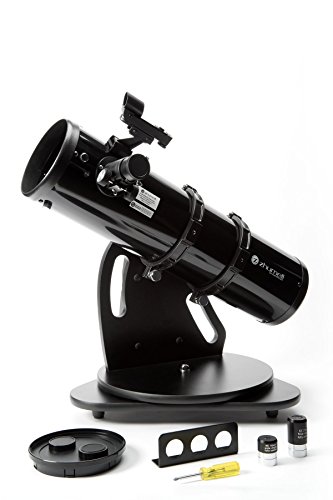
The Z130 takes the same 130mm aperture class as the AstroMaster 130EQ and mounts it as a tabletop Dobsonian instead: the tube sits in a low, rotating base that you place on a sturdy table or stand. There is nothing to align and nothing to balance, so it is the fastest reflector here from box to first view. The 130mm parabolic primary mirror is the headline feature, a mirror type usually reserved for larger scopes, and it delivers bright, sharp wide-field views.
Specs
- Optical design: Newtonian reflector with parabolic primary mirror
- Aperture: 130mm
- Focal length: 650mm
- Focal ratio: f/5
- Mount: Tabletop Dobsonian alt-azimuth base
- Eyepieces included: 25mm (26x) and 10mm (65x)
- Finder: Red dot finderscope
- Focuser: 1.25-inch rack-and-pinion
- Total kit weight: not stated
Who it’s for: Apartment dwellers, campers, and families who want big-aperture views with the simplest possible mount and easy storage between sessions.
Who should skip: Observers without a stable table or stand to put it on, and anyone who wants equatorial tracking for long observing sessions at high power.
Frequently Asked Questions
What can a beginner actually see through these telescopes?
All five show the Moon in sharp detail, Jupiter’s cloud bands and four bright moons, and Saturn’s rings. The 114mm and 130mm reflectors add hundreds of deep-sky objects, including the Orion Nebula, the Andromeda Galaxy, and bright globular clusters, especially from darker skies away from city lights.
Is a refractor or a reflector better for a first telescope?
Neither is universally better. Refractors like the AstroMaster 70AZ need no mirror alignment and suit lunar and planetary viewing. Reflectors give more aperture for the money, which wins for faint deep-sky objects, but their mirrors occasionally need collimation, a simple adjustment done with the tube’s built-in screws.
Do I need an equatorial mount as a beginner?
No. An alt-azimuth or Dobsonian mount is easier on your first nights because it moves the way you expect. An equatorial mount earns its keep later, when you observe at high power for long stretches and want to track objects with one knob instead of constantly nudging the tube in two directions.
What else should I budget for after buying the telescope?
Nothing is required, since every pick includes eyepieces and a finder. The most useful first extras are a red flashlight to protect your night vision, a planisphere or a free sky app to learn the constellations, and eventually a 2x Barlow lens to double the magnification of the eyepieces you already own.
Final Verdict
For most first-time buyers, the Celestron AstroMaster 130EQ is the best balance of aperture, mount, and long-term headroom, and it is the pick most likely to still satisfy you in your second winter of observing. Choose the AstroMaster 70AZ if simplicity and planetary views matter more than deep-sky reach, the Orion StarBlast II 4.5 EQ for the brightest wide fields in the smallest package, the Zhumell Z130 for big-aperture views with zero mount fuss, and the PowerSeeker 127EQ if equatorial tracking at the lowest kit cost is your priority. Any of the five will show you more of the winter sky than a cheap novelty scope ever will.
Product and ASIN Reference
| Product | ASIN |
|---|---|
| Celestron AstroMaster 70AZ Refractor Telescope | B000MLHMAS |
| Celestron PowerSeeker 127EQ Telescope | B0007UQNKY |
| Orion StarBlast II 4.5 EQ Reflector Telescope | B06XSM4R74 |
| Celestron AstroMaster 130EQ Newtonian Telescope | B000MLL6RS |
| Zhumell Z130 Portable Altazimuth Reflector Telescope | B07BRLSVWM |
More from Amazon
Programs that pair well with the guide above. Offers and eligibility are set by Amazon and may change.
Free shipping on eligible items, Prime Video and more. Eligible new members can start with a free trial.
Start a Prime free trialAudiobooks and podcasts to listen to on the go. Eligible new members can start with a free trial.
Try Audible freeAd-free music streaming. Eligible new subscribers can start with a free trial.
Try Music Unlimited freeA free business account with business pricing and bulk-buying tools for work, shop or home office.
Create a business accountAs an Amazon Associate we earn from qualifying purchases.







Write Your Review
No reviews yet. Be the first to share your experience!