
Key takeaways
- Compare the best approach shoes for scrambling and technical trails, with sticky rubber, climbing zones and supportive fits for rocky terrain.
Approach shoes sit in the gap between a hiking shoe and a climbing shoe. They use sticky rubber outsoles, a smooth climbing zone under the toes, and lace-to-toe closures borrowed from rock shoes, wrapped in an upper and midsole that can still handle miles of rough trail. For climbers walking into a crag, scramblers crossing fourth-class terrain, and hikers who regularly leave the dirt for slabs and talus, that hybrid design is far more capable than a standard trail shoe.
The five models below cover the main approaches to the category: a durable leather all-rounder, a heavy-duty classic for long walk-ins, a resoleable value pick, a waterproof option for wet ranges, and an ultralight knit shoe made to clip to a harness.
As an Amazon Associate, we earn from qualifying purchases.
How to Choose Approach Shoes
Rubber compound matters most. The outsole is what separates an approach shoe from a hiker. Soft, high-friction compounds such as Vibram Megagrip, Vibram Idrogrip, and Pomoca rubber grip smooth rock far better than ordinary trail lugs. Look for a flat, smooth climbing zone at the front of the sole, because that patch is what you edge and smear with on steeper steps.
Stiffness is a trade-off. A stiffer midsole edges well, supports your foot on long descents, and feels secure under a loaded pack, but it can feel clunky on easy trail miles. Softer shoes are more sensitive for fast approaches, yet they tire your feet on long, rocky walk-ins. Match the stiffness to the terrain you cover most.
Fit should be snug, not painful. Approach shoes are lasted closer than hiking boots so the foot does not roll inside the shoe on small holds. Many climbers size them close to their street shoe size for hiking comfort, or a touch snugger if low fifth-class climbing is on the menu. Leather uppers stretch with wear; knit uppers hold their shape but forgive less.
Consider weight and packability. If the shoes will hang from your harness on multi-pitch routes, every ounce counts and a compressible knit model makes sense. If they stay on your feet all day under a heavy pack, support and durability matter more.
Waterproofing is optional. A membrane keeps feet dry in wet grass and creek crossings, but it runs warmer and dries slowly once soaked. Most climbers working dry rock prefer a breathable shoe.
La Sportiva TX4 Evo

The TX4 Evo is the current flagship of La Sportiva’s Traverse X line and the most complete all-rounder in this guide. Its nubuck leather upper is wrapped in a recycled rubber rand and toe cap, so it shrugs off the abrasion that shreds mesh shoes in talus and cracks. Underfoot, a Traverse injection midsole with a co-molded TPU shank and the STB Control System keeps the shoe stable and torsionally stiff, and the Vibram Megagrip outsole pairs a dedicated climbing zone platform with an Impact Brake System heel for controlled descents.
A detail worth knowing about is the ESS Resole Platform, an insert that lets a cobbler replace the outsole without disturbing the midsole and fit, so the shoe can stay in service for years rather than a season. The Mythos lacing system runs far down the toe so you can snug the forefoot for a scramble and loosen it for the walk out. The fit is roomier than older TX models, which suits long days, though it gives up a little locked-in precision.
Specs
- Upper: Nubuck leather with recycled rubber rand and toe cap
- Lining: Recycled AirMesh
- Midsole: Traverse injection MEMlex EVA with co-molded TPU shank and STB Control System
- Outsole: Vibram Megagrip with Impact Brake System and Climbing Zone Platform
- Lug depth: 3 mm
- Weight: 12.6 oz (360 g) per shoe, manufacturer figure
- Special feature: ESS Resole Platform for straightforward resoling
Who it’s for: Climbers and scramblers who want one durable shoe for long approaches, via ferrata, and easy fifth-class terrain, and who value a resoleable build.
Who should skip: Weight counters building a fast-and-light kit, and anyone who wants a waterproof membrane.
La Sportiva TX4
The original TX4 remains a favorite for good reason: it is the heavy-duty workhorse of the TX family. A suede leather upper with a 1.5 mm PU TechLite rand and a full rubber toe cap gives it the toughness guides and big-wall climbers rely on when approaches involve miles of sharp rock and heavy loads. The injected EVA midsole is firmer and more supportive than the units in lighter shoes, and the STB Control System ties the upper and midsole together so the shoe tracks straight on uneven ground instead of rolling.
The Vibram MegaGrip outsole uses the same Impact Brake System heel geometry as its Evo sibling and keeps a smooth climbing zone at the toe, so the TX4 still edges and smears credibly when the trail turns into a scramble. Expect a break-in period: the leather starts stiff, then molds to your foot. In return you get one of the longest-lasting approach shoes in its class, with a roomy toe box that stays comfortable on all-day walk-ins.
Specs
- Upper: Suede leather with 1.5 mm PU TechLite rand and rubber toe cap
- Lining: Mesh
- Midsole: Shock-absorbing injected EVA with STB Control System
- Outsole: Vibram MegaGrip with Impact Brake System and climbing zone at the toe
- Lacing: Mythos lacing system
- Weight: 12.9 oz (365 g) per shoe, manufacturer figure
- Fit: Roomy toe box on La Sportiva’s Traverse last
Who it’s for: Mountain guides, big-wall climbers, and hikers who carry loads over rugged approaches and want maximum durability and support.
Who should skip: Climbers who prioritize a featherweight shoe for carrying over multi-pitch routes.
SCARPA Crux

The Crux is Scarpa’s long-running answer to the same brief, built around a 1.8 mm water-resistant suede upper, a full-coverage rubber toe rand, and a lace-to-toe closure that lets you dial in forefoot tension much like a climbing shoe. The Vibram Megagrip outsole delivers dependable friction on slabs and wet rock, while the 2D EVA-MP midsole keeps the ride firm enough for edging yet forgiving on the trail. It is a resolable design, which extends its working life well beyond most glued-together footwear.
Where the Crux stands out is value and versatility. It climbs confidently on moderate rock, hikes comfortably on the medium-length approaches most climbers actually do, and the suede build tolerates seasons of abuse in scree and brush. The fit runs on the narrower side, which narrow and medium feet tend to love for technical work, and the shoe needs some break-in before the leather softens. It is not the lightest shoe here and lacks a waterproof membrane, but as a durable, do-everything approach shoe it is easy to recommend.
Specs
- Upper: 1.8 mm water-resistant suede
- Lining: Polyester with recycled content
- Midsole: 2D EVA-MP
- Outsole: Vibram Megagrip
- Protection: Full-coverage rubber toe rand
- Closure: Lace-to-toe
- Weight: 15.2 oz (430 g) per shoe, manufacturer figure
Who it’s for: Climbers who want a durable, resoleable approach shoe that handles both hiking and moderate climbing.
Who should skip: Wide-footed users, who may find the last cramped, and anyone who needs a waterproof or ultralight shoe.
Salewa Wildfire GTX

Most approach shoes give up when the weather turns, but the Wildfire GTX is built for wet ranges and shoulder seasons. A Gore-Tex Extended Comfort membrane lines the upper, keeping out rain and wet grass while still breathing reasonably in cool conditions. Salewa’s EXA Shell cage wraps the midfoot for stability, and the 3F System connects the lacing to the heel so the back of the foot stays locked in on descents.
The Pomoca Speed MTN outsole uses a sticky compound with a defined climbing zone at the toe, and its lugs are aggressive enough for muddy trails and loose scree where smoother approach soles skate. The MFF+ footbed allows some volume adjustment for different sock thicknesses. The trade-offs are familiar: it runs warmer than the other shoes in this guide, dries slowly after a soaking, and the narrow alpine fit will not suit every foot. For via ferrata and damp alpine approaches, though, it is the most capable foul-weather option here.
Specs
- Upper: EXA Shell injected 3D cage over breathable mesh
- Membrane: Gore-Tex Extended Comfort
- Outsole: Pomoca Speed MTN with climbing zone
- Footbed: MFF+ multi-fit footbed
- Drop: 11 mm
- Weight: 13.9 oz (395 g) per shoe, manufacturer figure
- Fit: Precise alpine fit with 3F System heel retention
Who it’s for: Mountaineers and via ferrata users facing wet or mixed conditions who want waterproof protection in a technical shoe.
Who should skip: Desert and summer climbers, who will find the membrane hot, and wide-footed users.
La Sportiva TX2 Evo
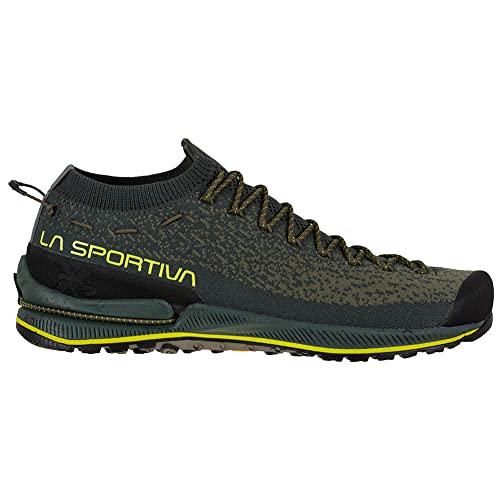
At the opposite end of the spectrum sits the TX2 Evo, the lightest shoe in La Sportiva’s TX line, purpose-built to disappear into a pack or hang from a harness. The recycled engineered-knit upper keeps weight down and breathes well, with polyurethane TechLite reinforcements at the toe and heel. The Vibram Idrogrip outsole is among the stickiest compounds in this guide, excelling on wet rock and slabs, and the Traverse Lite midsole with its co-molded TPU shank keeps the shoe flexible and sensitive underfoot.
A clever detail is the C2 Combo Cord lacing, which lets the pair snap together into a compact bundle for clipping to a harness or stashing in a pack lid. Like the TX4 Evo, the TX2 Evo is built on a resole platform, so its light weight does not have to mean a short life. Sensitivity is the headline: you feel the rock through these, which builds confidence on delicate friction moves. The compromises are support and durability: the knit upper and minimal midsole are not made for heavy packs or seasons of talus bashing.
Specs
- Upper: Recycled engineered knit with PU TechLite toe and heel reinforcements
- Midsole: Traverse Lite injection MEMlex EVA with co-molded TPU shank
- Outsole: Vibram Idrogrip with Impact Brake System and climbing zone
- Weight: 10.2 oz (290 g) per shoe, manufacturer figure
- Lacing: C2 Combo Cord system joins the pair for carrying
- Special feature: Resole platform construction
Who it’s for: Multi-pitch climbers and fast-and-light scramblers who carry their shoes over routes and want maximum sensitivity at minimum weight.
Who should skip: Anyone carrying heavy loads on long approaches, and users who need a leather upper’s abrasion resistance.
Frequently Asked Questions
What is the difference between approach shoes and hiking shoes?
Approach shoes use softer, stickier rubber with a smooth climbing zone at the toe, a stiffer and lower platform for edging, and lace-to-toe closures for a precise fit. Hiking shoes use harder, deeper-lugged soles built for dirt and mileage, which grip poorly on smooth rock. If your hikes include scrambling or slabby rock, approach shoes are the safer tool.
How should approach shoes fit compared with street shoes?
They should feel snug through the midfoot and heel with toes close to the front but not curled. Many people take their normal street shoe size for all-day approaches, or go slightly snugger for technical climbing. Leather models stretch a little with break-in, while knit models keep their out-of-the-box shape.
Can approach shoes handle long hikes and backpacking?
Stiffer leather models such as the TX4 and Crux handle long approaches and moderate loads well. Ultralight knit models are better kept to shorter approaches, because their minimal midsoles fatigue feet and wear faster under heavy packs.
Are approach shoes waterproof?
Most are not. Leather and knit models resist light moisture but wet through in sustained rain. If you approach in wet ranges, choose a membrane model such as the Wildfire GTX, and accept that it runs warmer and dries more slowly.
Final Verdict
For most climbers and scramblers, the La Sportiva TX4 Evo is the best approach shoe to buy: it blends a tough leather build, sticky rubber, and a resoleable platform into a shoe that works on nearly any approach. If durability under heavy loads matters more, the original TX4 remains a proven alternative, while the SCARPA Crux delivers similar versatility in suede. Choose the Salewa Wildfire GTX when wet weather is a regular part of your approaches, and reach for the TX2 Evo when the shoes will spend as much time clipped to your harness as on your feet.
Product and ASIN Reference
| Product | ASIN |
|---|---|
| La Sportiva TX4 Evo Men’s Approach Shoes (Carbon/Cherry Tomato) | B0CRK6JZ8Y |
| La Sportiva TX4 Men’s Approach Shoes (Carbon/Flame) | B07F8VHMWL |
| SCARPA Crux Men’s Approach Shoes (Shark/Tonic) | B074QT2W9T |
| Salewa Wildfire GTX Men’s Approach Shoes (Black Olive/Wallnut) | B08B1LJ5DW |
| La Sportiva TX2 Evo Men’s Approach Shoes (Beetle/Citrus) | B09MDHVHM1 |
More from Amazon
Programs that pair well with the guide above. Offers and eligibility are set by Amazon and may change.
Free shipping on eligible items, Prime Video and more. Eligible new members can start with a free trial.
Start a Prime free trialAudiobooks and podcasts to listen to on the go. Eligible new members can start with a free trial.
Try Audible freeAd-free music streaming. Eligible new subscribers can start with a free trial.
Try Music Unlimited freeA free business account with business pricing and bulk-buying tools for work, shop or home office.
Create a business accountAs an Amazon Associate we earn from qualifying purchases.
Write Your Review
No reviews yet. Be the first to share your experience!