
Key takeaways
- The best down jackets compared by fill power, fill weight and shell: ultralight packable layers, warm everyday puffers and a synthetic pick for wet days.
A good down jacket gives you real winter warmth in a package that feels like a heavy sweater, and that is why down still beats every other insulation for cold, dry weather. The trouble is that spec sheets make comparisons harder than they should be. Brands lead with fill power, a number that sounds like a warmth score but only describes how much a single ounce of down expands. Two jackets can share the same fill power and differ enormously in warmth, because total warmth depends just as much on how many ounces of fill are sewn inside.
This guide compares five jackets across the main classes a buyer is likely to cross-shop: a versatile 800-fill all-rounder, an ultralight layer for weight-conscious hikers, a heavier 700-fill workhorse for deep cold, a down and synthetic hybrid built around a reflective lining, and a fully synthetic jacket for damp climates. Each pick lists its fill power, fill type and best use, so you can match the jacket to your winters instead of to a marketing number.
As an Amazon Associate, we earn from qualifying purchases.
Quick answer
For most people, the Patagonia Down Sweater Hoody is the one to buy: 800-fill down, a durable recycled ripstop shell and enough loft for everyday winter wear. Hikers counting every ounce should choose the Mountain Hardwear Ghost Whisperer/2 Hoody instead, and anyone in a wet climate is better served by the synthetic North Face ThermoBall Eco Hoodie 2.0.
How to choose
Fill power measures loft per ounce. Down rated at 550 fill expands less per ounce than down rated at 850, so a maker needs more of the lower-grade fill to build the same thickness of insulation. High fill power is mainly a weight and packability advantage, not an automatic warmth advantage. A jacket with a thin layer of 900-fill down can be colder than one stuffed generously with 650-fill. Always read fill power and fill weight together: the first tells you how efficient the down is, the second how much of it you are wearing.
Down and synthetic fills behave differently, and the honest choice depends on your climate. Down offers the best warmth for its weight and compresses small, but untreated down clumps and loses most of its loft when wet. Hydrophobic treatments slow that collapse without eliminating it. Synthetic insulation is heavier and bulkier for the same warmth, yet it keeps insulating when damp and dries faster, which matters in maritime winters.
Shell fabric decides how the jacket survives daily use. Ultralight models use thin 7 to 15 denier nylon that keeps weight down but snags more easily. Everyday jackets use tougher 20 to 50 denier shells that shrug off pack straps and dog claws. A DWR finish sheds light snow and brief drizzle; no down jacket shell is waterproof, and sustained rain calls for a waterproof layer over the top.
Finally, separate the classes. Packable mid-layers are cut slim to fit under a shell and carry modest fill for active or shoulder-season use. Expedition parkas carry several times the fill weight, longer cuts and storm hoods, and are a different category entirely. A fashion puffer sits outside both classes, with unspecified fill and shells chosen for appearance. Buy the class that matches your coldest realistic day, and leave room in the fit for a fleece underneath.
Patagonia Down Sweater Hoody

The Down Sweater Hoody is the benchmark all-rounder in this category, and the men’s version is listed on Amazon under ASIN B0BGPCGZWF. It uses 800-fill-power Responsible Down Standard goose down, with roughly 5.3 ounces of fill in a men’s medium in the current version, a meaningful amount for a jacket that still packs into its own chest pocket. The shell is NetPlus ripstop nylon woven from recycled fishing nets, finished with a PFAS-free DWR coating, and it is noticeably sturdier than the shells on ultralight rivals.
That balance of loft and durability is the use case: one jacket for commuting, travel, cold dog walks and three-season mountain trips where a shell goes over the top at camp.
Two honest caveats apply. Patagonia does not treat this down to resist water, so the jacket depends on its DWR and on you keeping it dry in sustained rain. And like every jacket here, it carries no standardized temperature rating, because no such standard exists for jackets the way one does for sleeping bags. Judge it as a freezing-point layer that goes colder with a shell over it, not as a standalone answer to extreme cold.
Mountain Hardwear Ghost Whisperer/2 Hoody

The Ghost Whisperer/2 Hoody is the ultralight specialist, listed on Amazon under ASIN B08W3NZDSY for the men’s version. It is built around 800-fill-power Responsible Down Standard down inside a whisper-thin 10 denier ripstop nylon shell, and a men’s medium comes in under nine ounces all in.
The trade is total fill. To reach that weight, Mountain Hardwear uses far less down than the Patagonia above, so despite matching its fill power this is a colder jacket. Think of it as insurance for summer alpine nights, shoulder-season backpacking and travel in mild winter cities, worn over a fleece and under a shell when the wind picks up. As a standalone layer for a stationary January evening, most people will want more insulation.
The thin shell also asks for care. It handles the light abrasion of normal wear, but it is the wrong choice for bushwhacking or daily abuse from a heavy pack with exposed hardware. Buyers who run cold, or who mostly stand still outdoors in winter, should read its spec sheet as a warning rather than a promise and pick a jacket with more fill weight instead.
Marmot Guides Down Hoody

The Guides Down Hoody is the warmth-first pick, with the men’s medium in black listed on Amazon under ASIN B075LF5TH4. It uses 700-fill-power down treated with Down Defender, Marmot’s hydrophobic finish that helps the clusters resist moisture from melting snow and damp air. The fill weight is generous by the standards of this guide, and the shell is a tougher polyester ripstop than the ultralight models use, so the jacket lofts high and stays lofted through a long day.
This is the jacket for standing on a sideline, working outdoors in cold weather, ice fishing, or walking a dog through the coldest weeks of the year. It still packs down reasonably well for travel, but at well over a pound it is not the layer a backpacker reaches for first.
The 700 fill power deserves a word, because it looks like a downgrade next to the 800-fill jackets above. It is not, in practice. Marmot simply uses more of a slightly less lofty down, and the result is a warmer jacket that costs its owner weight and packed size rather than comfort.
Columbia Voodoo Falls 590 TurboDown Hooded Jacket
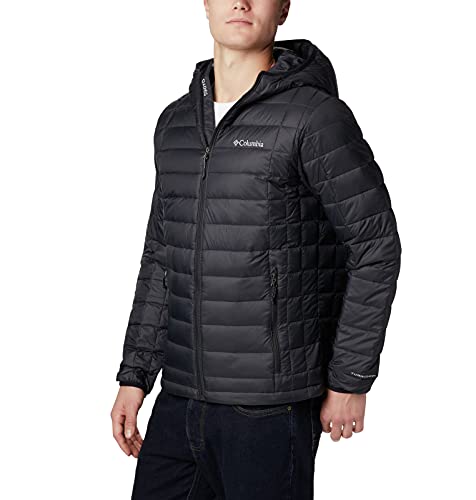
The Voodoo Falls is the value pick, listed on Amazon under ASIN B01883KR26 in black. Its insulation is TurboDown, a blend that pairs 550-fill-power down with synthetic insulation, and the lining is Columbia’s Omni-Heat reflective material, which reflects body heat back toward the wearer through a pattern of small metallic dots.
One labeling point needs clearing up: the 590 in the name is not a fill power. It is Columbia’s name for this TurboDown performance level, and the down inside is 550 fill. That is not a criticism of the jacket, which is warm, light and well suited to everyday winter use, but buyers comparing numbers across brands should know the figure measures something different from the fill power quoted for the other jackets here.
The blend construction has a genuine upside. The synthetic portion keeps some loft when the down gets damp, and the reflective lining adds warmth without bulk, so the jacket feels slimmer than its warmth suggests. It suits commuters and casual wear in cold, mostly dry weather, and travels well where a radiator can dry it overnight. It will not match the deep-cold margin of the Marmot, and it is not built for backcountry abuse.
The North Face ThermoBall Eco Hoodie 2.0

The ThermoBall Eco Hoodie 2.0 is the synthetic option, listed on Amazon under ASIN B0CNBVTG13. Instead of down clusters it uses ThermoBall Eco insulation, small round clusters of 100 percent recycled polyester that mimic the structure of down while behaving like a synthetic. The clusters keep insulating when wet, dry faster than down, and need no special handling in a home washing machine.
Synthetic fill has real costs, and this jacket shows both. It is heavier and less compressible than a down jacket of similar warmth, and synthetic clusters slowly lose loft over years of being stuffed and worn, where good down can recover for a decade or more. Expect a shorter peak-performance life than the Patagonia offers.
In exchange, this is the jacket that makes sense where down struggles: coastal winters, ski towns where storms arrive wet, active days when sweat soaks insulation from the inside, and households that prefer to avoid animal products entirely. For dry, settled cold, down remains the better buy, and the other picks here will feel warmer at the same weight.
Who should skip a down jacket
Skip down if your winter is mostly rain. In a climate of near-freezing drizzle, untreated down spends the season damp and flat, and even treated down needs regular drying. A synthetic jacket like the ThermoBall, or a waterproof insulated coat, will serve you better. Skip the ultralight class if you run cold and spend your time standing still; spectators, anglers and market vendors need fill weight, not a high fill power number. And if you need one garment for stationary work in severe sub-zero cold, none of these jackets is the right category: look at expedition parkas with several times the fill weight and a longer, storm-sealed cut.
Frequently Asked Questions
What does fill power actually measure?
Fill power measures how much space one ounce of down occupies when it lofts, expressed in cubic inches. Higher numbers mean the down traps the same amount of air with less weight.
Is a higher fill power jacket always warmer?
No. Warmth comes from the total thickness of trapped air, which depends on fill power multiplied by how much fill is present. A jacket with a small amount of 900-fill down can be colder than a generously filled 650-fill jacket.
Can I wear a down jacket in the rain?
Light snow and brief drizzle are fine, because DWR finishes shed small amounts of moisture. Sustained rain soaks through any down jacket shell, and wet down loses most of its insulating loft. In real rain, wear a waterproof shell over the jacket or choose synthetic insulation, which keeps working when damp.
How should I store a down jacket?
Hang it loosely in a closet or keep it in a large breathable storage sack. Storing down compressed in its stuff sack for months at a time can permanently reduce loft, and a jacket that has been crushed may need a long hang, or a gentle tumble dry cycle following the care label, before its fill recovers fully.
Final verdict
Match the jacket to the job. The Patagonia Down Sweater Hoody is the best single answer for most buyers, with 800-fill down, a durable shell and enough fill for real winter. The Ghost Whisperer/2 Hoody trades warmth for a feathery packed weight that hikers will love. The Marmot Guides Down Hoody is the warmest and toughest pick here for stationary cold. The Columbia Voodoo Falls delivers its hybrid warmth at the friendliest cost of entry, and the ThermoBall Eco Hoodie 2.0 is the right call wherever winters run wet.
Product and ASIN Reference
| Product | ASIN |
|---|---|
| Patagonia Down Sweater Hoody | B0BGPCGZWF |
| Mountain Hardwear Ghost Whisperer/2 Hoody | B08W3NZDSY |
| Marmot Guides Down Hoody | B075LF5TH4 |
| Columbia Voodoo Falls 590 TurboDown Hooded Jacket | B01883KR26 |
| The North Face ThermoBall Eco Hoodie 2.0 | B0CNBVTG13 |
FAQ
What does fill power actually measure?
Is a higher fill power jacket always warmer?
Can I wear a down jacket in the rain?
How should I store a down jacket?
More from Amazon
Programs that pair well with the guide above. Offers and eligibility are set by Amazon and may change.
Free shipping on eligible items, Prime Video and more. Eligible new members can start with a free trial.
Start a Prime free trialAudiobooks and podcasts to listen to on the go. Eligible new members can start with a free trial.
Try Audible freeAd-free music streaming. Eligible new subscribers can start with a free trial.
Try Music Unlimited freeA free business account with business pricing and bulk-buying tools for work, shop or home office.
Create a business accountAs an Amazon Associate we earn from qualifying purchases.
Write Your Review
No reviews yet. Be the first to share your experience!