
Key takeaways
- Find the best car battery chargers for cold weather, from smart maintainers and fast chargers to dual-bank and AGM lithium models built for winter.
Cold weather is hard on a car battery in two ways at once. Low temperatures slow the chemical reaction inside the battery, so it delivers less cranking power on the very mornings when a cold engine needs more of it, and a battery that sits partly discharged through a freeze can suffer damage that shortens its life. A plug-in charger is the simplest defense: it refills the battery gently, holds it at full charge while the vehicle sits, and, on the better models, adjusts its output for the temperature in your garage.
The chargers below are all plug-in units for 12-volt automotive batteries, with one dual-bank model for households running two vehicles. They cover five distinct jobs: an all-round smart charger and maintainer, a fast charger for a battery that needs charge today, a low-amp trickle charger for long storage, a two-bank unit that minds two batteries at once, and a mode-based charger with dedicated settings for AGM and lithium batteries. Every unit listed includes temperature compensation or a listed cold-weather feature, because a charger that ignores temperature will undercharge in deep cold and can overcharge when the weather warms.
As an Amazon Associate, we earn from qualifying purchases.
Quick answer
For most drivers, the NOCO GENIUS10 is the pick: a 10-amp smart charger and maintainer for 6-volt and 12-volt lead-acid and lithium batteries, with an integrated thermal sensor that adjusts the charge for ambient temperature. If a battery is already flat and time matters, the 15-amp Schumacher SC1280 refills it faster, while the Battery Tender Plus suits slow, set-and-forget storage care.
NOCO GENIUS10 10A Smart Charger and Maintainer
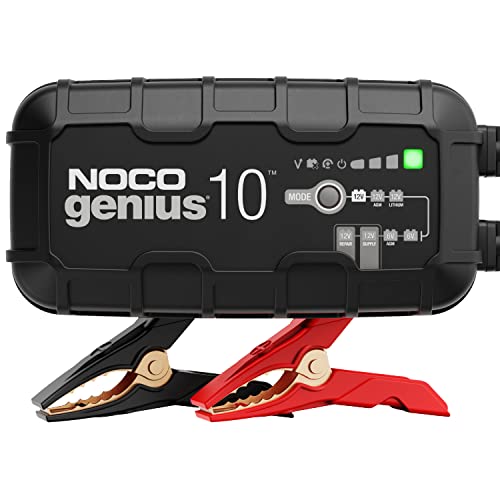
The GENIUS10 is NOCO’s 10-amp fully automatic smart charger, and it earns the top spot here because it covers the widest range of winter jobs in one compact unit. It charges 6-volt and 12-volt batteries at up to 10 amps, which is enough current to refill a typical car battery overnight rather than over a weekend, and it is listed for lead-acid types including flooded, gel, AGM, and maintenance-free batteries, plus lithium LiFePO4 batteries. NOCO rates it for charging batteries up to 230 amp-hours and for maintaining batteries of any size once they are full.
The feature that matters most for this guide is the integrated thermal sensor. The listing describes precision charging that adjusts for ambient temperature, preventing overcharging in warm conditions and undercharging in cold ones, and the unit’s listed operating range runs from -4 degrees Fahrenheit to 104 degrees Fahrenheit. In a cold garage, that compensation raises charging voltage the way a chilled battery needs, instead of leaving it short of full.
The GENIUS10 also works as a maintainer that can stay connected without overcharging, includes a desulfator function, can charge from as low as 1 volt, and offers a Force Mode for a battery that reads zero volts. For a single charger to keep in the garage through winter, this is the most complete package here.
Schumacher SC1280 15A Rapid Charger and Maintainer

When a battery is flat on a cold morning and the car needs to move today, charge speed is the whole point, and that is the Schumacher SC1280’s job. Its headline figure is 15 amps of rapid charging for 12-volt batteries, the highest output in this guide, paired with a 3-amp maintain mode for holding a battery at full charge afterward. For 6-volt batteries it offers a 2-amp setting, and the unit detects the battery voltage automatically.
The SC1280 is listed for standard, AGM, gel, and deep-cycle batteries, which covers the battery under the hood of most cars and trucks as well as the deep-cycle battery in a plow truck or winter work vehicle. It is fully automatic and microprocessor controlled, with multi-stage charging that moves through the charge cycle on its own and float-mode monitoring once the battery is full, so it can be left connected after the fast charge finishes rather than needing to be unplugged on a timer.
Schumacher also lists an auto desulfator mode and a battery tester function in its four-in-one feature set. The honest trade-off is temperature: unlike the NOCO units here, the SC1280’s listing does not headline a thermal sensor, so it is best viewed as the fast-recovery tool in a winter kit, with a temperature-compensating maintainer handling long storage duty.
Battery Tender Plus 1.25A Trickle Charger and Maintainer

The Battery Tender Plus, model 021-0128, is the slow and steady entry in this guide: a 12-volt charger with a 1.25-amp output, built for vehicles that sit for weeks or months through the winter. That low output is deliberate. A gentle charge suits a battery that is already in decent shape and simply needs to be topped up and then held at the proper storage voltage, which is exactly the duty cycle of a summer car parked from November to March.
Deltran’s charger runs a complete four-step program: initialization, bulk charge, absorption mode, and float mode. Once the battery is full, it switches to float and maintains it at storage voltage without the damaging effects the maker attributes to old-fashioned constant trickle chargers. Crucially for cold climates, the Plus is temperature compensated, adjusting its output for ambient conditions, and it is spark-proof with reverse polarity protection and short-circuit protection built in.
The listing covers all lead-acid batteries, flooded or sealed maintenance-free, including AGM and gel cell types, and retailer specifications put its charging range at batteries from 14 to 80 amp-hours. It ships with a quick-connect harness and both ring terminal and alligator clip leads, and it carries a 10-year warranty, the longest backing in this guide. It will not rescue a deeply discharged battery quickly, and it has no lithium mode, but for unattended winter storage of a lead-acid battery it remains a benchmark design.
NOCO GENIUS2X2 4A Two-Bank Smart Charger

Households with two vehicles, or one vehicle plus a snowmobile, plow, or boat battery, face a small logistics problem in winter: one charger, two batteries, and a lot of swapping leads in a cold garage. The NOCO GENIUS2X2 solves it with two independent banks in a single housing. Total output is 4 amps, delivered as 2 amps per bank, and each bank charges and maintains its own battery on its own program, so the two batteries need not match in size, age, or chemistry.
Like the other NOCO units here, the GENIUS2X2 handles 6-volt and 12-volt batteries and is listed for lead-acid types including flooded, gel, AGM, and maintenance-free, plus lithium LiFePO4. Each bank gets the same protective features as the single-bank models: temperature compensation through an integrated thermal sensor, overcharge protection, an automatic maintainer and trickle function, and a desulfator. Because the banks are independent, you can set one bank to a lead-acid mode for the truck and the other to lithium mode for a powersports battery, and leave both connected all winter.
Two amps per bank is maintenance pace rather than recovery pace, so this unit will refill a flat car battery slowly. Its strength is continuous care: two batteries held at full charge, through freeze and thaw, with no lead swapping and no second outlet taken up.
NOCO GENIUS5 5A Charger With AGM and Lithium Modes

Modern vehicles increasingly ship with AGM batteries, and a growing number of owners have fitted lithium LiFePO4 batteries, and both chemistries want a different charging profile from a plain flooded battery. The NOCO GENIUS5 is the pick built around that reality. It is a 5-amp charger for 6-volt and 12-volt batteries, and its mode button offers dedicated settings that include a 12-volt AGM mode and a 12-volt lithium mode alongside the standard 12-volt and 6-volt modes, so the charger applies the voltage profile the selected chemistry calls for rather than a one-size compromise.
NOCO lists the GENIUS5 for wet, gel, maintenance-free, calcium, EFB, and AGM lead-acid batteries, and for 12-volt lithium batteries with a battery management system. It charges batteries up to 120 amp-hours and maintains batteries of any size. An integrated thermal sensor provides temperature compensation across a listed operating range of -4 to 104 degrees Fahrenheit, adjusting the charge so a cold battery is not left undercharged.
Two recovery tools round out the package: a repair mode aimed at sulfated lead-acid batteries, and the ability to charge from as low as 1 volt, with Force Mode for manually charging a battery that reads zero volts. The housing carries an IP65 rating. If your garage holds a mix of battery chemistries, this is the charger that treats each one on its own terms.
How to choose
Match the charger’s output to the job first. Amps decide pace: a 1.25-amp trickle unit is for holding a healthy battery through storage, a 5-amp charger refills a car battery overnight, a 10-amp unit does it faster and handles larger batteries, and a 15-amp charger is for getting a flat battery back into service the same day. As a rough guide from the listings, check the charger’s rated amp-hour range against your battery’s size, since a small maintainer may never finish a large, deeply discharged battery.
Second, match the modes to your battery chemistry. Flooded, AGM, gel, and lithium batteries each have a preferred charging profile. If your vehicle has an AGM battery, choose a charger with a stated AGM setting or explicit AGM support; if it has a lithium battery, a dedicated lithium mode is not optional. Read the battery label before you buy, not after.
Third, for cold climates, look for temperature compensation by name. A thermal sensor or temperature-compensated charge adjusts voltage as the garage cools and warms, which protects the battery at both extremes of a northern winter. Also weigh how the charger will live: spark-proof and reverse-polarity protection and a quick-connect harness matter more in February than they do on the product page.
Who should skip
Skip this entire category if your battery keeps going flat because of a failing alternator, a parasitic draw, or a battery at the end of its service life. A charger will refill the battery every night and mask the fault while it gets worse; have the charging system and the battery load-checked first, and replace a battery that no longer holds a charge.
Skip the low-amp trickle pick if your need is recovery rather than storage, since 1.25 amps will take days on a flat car battery. Skip plug-in chargers altogether if the vehicle parks outdoors with no outlet within reach of an extension cord, and never run any of these units from a generator or inverter unless the maker allows it. Finally, owners of 24-volt vehicles should look elsewhere, as every charger here is a 6-volt and 12-volt, or 12-volt only, unit.
Frequently Asked Questions
Can I leave a smart charger connected all winter?
Yes, that is what the maintainer and float functions on these chargers are designed for. Once the battery reaches full charge, a smart charger drops to a maintenance output that offsets natural self-discharge without overcharging, and temperature compensation helps because the maintenance voltage adjusts as the garage temperature swings.
Why does temperature compensation matter in cold weather?
A cold battery needs a higher charging voltage to reach a full charge, while a warm battery needs less to avoid overcharging. A charger without compensation applies the same voltage in January as in July, so it tends to undercharge in deep cold, leaving the battery partly empty and more vulnerable to freezing and sulfation. A thermal sensor reads the ambient temperature and adjusts the charge automatically.
Will one of these chargers revive a completely dead battery?
Sometimes, within limits. The NOCO GENIUS10 and GENIUS5 can charge batteries from as low as 1 volt, and their Force Mode can begin charging a battery that reads zero volts, while repair and desulfator modes target sulfation on lead-acid batteries. A battery with an internal short or a cracked case cannot be saved by any charger, and a revived battery that has been deeply discharged repeatedly will usually have lost capacity.
What size charger does a typical car battery need?
For maintenance and overnight charging, 5 to 10 amps suits most car batteries, and the listings here rate the 5-amp GENIUS5 for batteries up to 120 amp-hours and the 10-amp GENIUS10 up to 230 amp-hours. A 1.25-amp unit like the Battery Tender Plus is sized for storage duty on batteries in its listed 14 to 80 amp-hour range. Bigger is faster, not better, for long-term float care.
Final verdict
For a single charger to own through winter, buy the NOCO GENIUS10: 10 amps of temperature-compensated charging for lead-acid and lithium batteries, with maintenance duty covered. Add the Schumacher SC1280 if same-day recovery from flat matters, choose the Battery Tender Plus for a stored car on a lead-acid battery, the GENIUS2X2 for two vehicles, and the GENIUS5 when dedicated AGM and lithium modes are the priority.
Product and ASIN Reference
| Product | ASIN |
|---|---|
| NOCO GENIUS10 10A Smart Charger and Maintainer | B07W3QT226 |
| Schumacher SC1280 15A Rapid Charger and Maintainer | B0797KK3N2 |
| Battery Tender Plus 1.25A Trickle Charger and Maintainer | B00068XCQU |
| NOCO GENIUS2X2 4A Two-Bank Smart Charger | B08F37P7H3 |
| NOCO GENIUS5 5A Charger With AGM and Lithium Modes | B07W8KJH44 |
FAQ
Can I leave a smart charger connected all winter?
Why does temperature compensation matter in cold weather?
Will one of these chargers revive a completely dead battery?
What size charger does a typical car battery need?
More from Amazon
Programs that pair well with the guide above. Offers and eligibility are set by Amazon and may change.
Free shipping on eligible items, Prime Video and more. Eligible new members can start with a free trial.
Start a Prime free trialAudiobooks and podcasts to listen to on the go. Eligible new members can start with a free trial.
Try Audible freeAd-free music streaming. Eligible new subscribers can start with a free trial.
Try Music Unlimited freeA free business account with business pricing and bulk-buying tools for work, shop or home office.
Create a business accountAs an Amazon Associate we earn from qualifying purchases.








Write Your Review
No reviews yet. Be the first to share your experience!