
Key takeaways
- Five climbing shoes for beginner and intermediate climbers compared: flat, comfortable picks for long sessions plus step-up models for technical edging.
A first pair of climbing shoes shapes how quickly footwork skills develop. Shoes that are flat, supportive, and comfortable enough to wear for a full session let new climbers practice precise foot placements instead of rushing through climbs to escape sore feet. A beginner shoe still needs sticky rubber and a secure heel so small footholds feel trustworthy from the first routes.
This guide compares five rock climbing shoes that cover the path from a first season in the gym to confident intermediate climbing outdoors. The list includes relaxed lace-up and hook-and-loop models built for all-day comfort, a women’s-specific all-rounder with a mild downturn, and one stiffer, more asymmetric step-up shoe for climbers whose footwork is ready for technical edging. Every model here is a dedicated rock shoe for roped climbing and bouldering, not an approach shoe or a mountaineering boot.
As an Amazon Associate, we earn from qualifying purchases.
How to Choose Climbing Shoes as a Beginner or Intermediate
Fit matters more than any single feature. Climbing shoes should feel snug everywhere, with toes flat or gently curled at the front and no empty space in the heel, but they should not cause sharp pain. Beginners often do best starting at or near street shoe size in a comfort-oriented model, because a fit that can stay on between climbs gets far more practice time than an aggressive fit that has to come off after every route.
Last shape is the second decision. Flat, low-asymmetry lasts keep the foot in a natural position and suit long gym sessions, slab climbing, and multi-pitch routes. A mild downturn with moderate asymmetry points the big toe and adds power on steeper ground and smaller edges, at the cost of comfort over a long day. Most climbers progress fastest by starting flat and moving to a downturned model only when routes demand it.
Closure style is a matter of routine. Laces give the most precise adjustment across the whole foot and handle swelling on long days, which is why most all-day and traditional climbing shoes use them. Hook-and-loop straps go on and off in seconds, a real advantage for bouldering and gym sessions where shoes come off between attempts.
Upper material affects how the fit changes over time. Leather uppers, lined or unlined, stretch and mold to the foot, so a leather shoe that feels very snug at first often settles into a comfortable shape. Synthetic and microfiber uppers stretch far less, so the fit bought is close to the fit kept. Rubber compound and thickness trade grip against durability: softer, thinner rubber feels more sensitive and sticks well, while thicker soles last longer and support the foot on small edges, which many beginners appreciate while foot strength builds.
La Sportiva Tarantulace

The Tarantulace is the lace-up counterpart to La Sportiva’s long-running entry-level Tarantula line, built on the flat RN 45 last with a rounded toe box and low asymmetry. That shape keeps the foot relaxed and makes the shoe a practical default recommendation for a first pair: it edges adequately on gym holds and easy rock, smears comfortably on slabs, and can stay on through a long session without forefoot fatigue.
The unlined leather upper stretches as it breaks in and molds to the foot, so the fit improves over the first several sessions. A 1.8 mm LaspoFlex midsole adds underfoot support that newer climbers generally appreciate on longer routes. The 5 mm FriXion RS sole is thicker than the rubber on performance models, which trades a little sensitivity for durability and a more forgiving feel while foot placements are still being learned.
Specs
- Upper: Unlined leather
- Midsole: 1.8 mm LaspoFlex
- Outsole: 5 mm FriXion RS rubber
- Last: RN 45, flat profile, low asymmetry, rounded toe
- Closure: Lace-up
- Construction: Slip-lasted
- Weight: 9.3 oz (260 g) per shoe
- Sizes: EU 34 to 48, in half sizes
Who it’s for: Beginners buying a first pair, and intermediates who want a comfortable lace-up for long gym sessions, slabs, and multi-pitch days.
Who should skip: Climbers working steep boulder problems or tiny edges, where the flat last and thick sole give up precision to downturned models.
SCARPA Origin

The SCARPA Origin is a comfort-first shoe for new climbers who prefer straps to laces. Its FFX last is flat with only slight asymmetry, and the padded, suede upper is shaped to be wearable straight away rather than needing a long break-in. SCARPA’s PAF heel system distributes pressure around the Achilles area, which helps the heel feel secure without the pinching that puts beginners off performance fits.
A nylon midsole that runs three-quarters of the shoe’s length keeps the platform supportive, while the 5 mm Vision rubber outsole provides the grip expected for gym plastic and outdoor rock at moderate grades. Two hook-and-loop straps make the Origin easy to pull off between climbs, and SCARPA lists the shoe as resoleable, so a worn sole does not have to end its life. For a first shoe that will see heavy gym use, that combination is well judged.
Specs
- Upper: 1.8 mm suede
- Midsole: 1.4 mm nylon, three-quarter length
- Outsole: 5 mm Vision rubber
- Last: FFX, flat profile, slight asymmetry
- Closure: Dual hook-and-loop straps
- Heel: PAF heel system
- Weight: 7.6 oz (215 g) per half pair, size EU 40
- Sizes: EU 39 to 50
Who it’s for: New climbers who want a forgiving, strap-closure shoe for gym climbing and easy outdoor routes, especially those who find aggressive heels uncomfortable.
Who should skip: Climbers with narrow, low-volume feet may find the comfort fit roomy, and anyone climbing steep, technical routes will outgrow the flat profile quickly.
Black Diamond Momentum

Black Diamond designed the Momentum as an entry-level shoe that borrows its priorities from gym training: breathability, easy on-off, and a neutral shape that stays comfortable through high-repetition sessions. The micro suede upper uses an engineered knit tongue that stretches over the instep, which helps the shoe fit a range of foot shapes without pressure points.
Underfoot, the molded Black Label rubber outsole is 4.3 mm thick, giving a consistent platform for edging practice and smearing drills. The last is neutral and flat with a soft-flex midsole, so the Momentum behaves like a training shoe rather than a precision instrument: supportive enough for long circuits, relaxed enough to keep on while resting between problems. Two hook-and-loop straps handle closure, keeping transitions fast during bouldering sessions.
Specs
- Upper: Micro suede with engineered knit tongue
- Midsole: Soft-flex midsole
- Outsole: 4.3 mm Black Label molded rubber
- Last: Neutral, flat profile
- Closure: Dual hook-and-loop straps
- Weight: 581 g per pair (manufacturer figure)
- Sizes: EU 37.5 to 47
Who it’s for: Beginners and gym-focused climbers who climb several times a week and want a breathable, comfortable shoe for training volume and bouldering circuits.
Who should skip: Climbers who spend most of their time on outdoor sport routes or cracks, where a stiffer, more protective shoe serves better than this soft, gym-oriented design.
SCARPA Vapor V Women’s
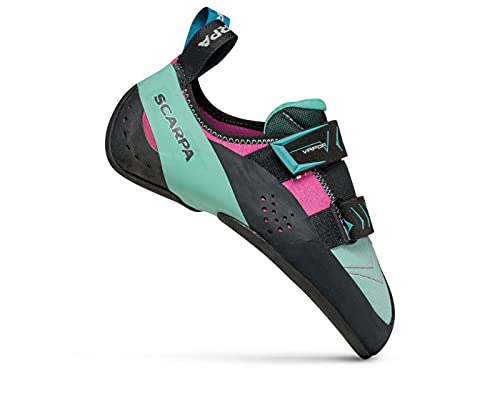
The Vapor V is the step up in this list for women climbers moving beyond beginner grades. Its FRW last is moderately downturned and moderately asymmetric, a shape that drives power through the big toe on small edges and pockets while staying wearable on vertical terrain. SCARPA’s Bi-Tension active rand wraps tension along both sides of the shoe and under the toes, linking support to sensitivity instead of simply stiffening the whole platform.
The microfiber upper holds its shape with minimal stretch, so the performance fit stays consistent over the shoe’s life. A 3.5 mm Vibram XS Grip 2 outsole is softer and stickier than the rubber on the beginner models above, improving friction on smears and steep rock, while the Flexan midsole keeps enough structure for standing on edges. Dual hook-and-loop straps and an enlarged rubber toe patch round out a shoe aimed at sport climbing and bouldering at intermediate grades and beyond.
Specs
- Upper: Microfiber
- Midsole: Flexan 1.0 mm
- Outsole: 3.5 mm Vibram XS Grip 2 rubber
- Last: FRW, moderately downturned, moderately asymmetric
- Closure: Dual hook-and-loop straps
- Rand: Bi-Tension active rand
- Weight: 7.1 oz (200 g) per half pair, size EU 38
- Sizes: Not stated
Who it’s for: Intermediate women climbers, especially those with lower-volume feet, who want one shoe for sport climbing, bouldering, and gym training on steeper ground.
Who should skip: Beginners, whose feet will tire quickly in a downturned fit, and climbers who mostly climb slabs or long, easy multi-pitch routes where comfort matters more than toe power.
La Sportiva Miura

The Miura has been La Sportiva’s benchmark lace-up for technical face climbing for decades, and it earns its place here as the step-up option for intermediates whose footwork has outgrown flat shoes. The PD 75 last gives a performance fit with high asymmetry, and the slingshot rand connects to a powerhinge under the shoe that keeps the toe engaged on edges instead of rolling off them.
A leather upper with a Dentex lining controls stretch, so the precise fit lasts, and the speed lacing system lets the tension be tuned from toe to ankle in one pull. The 1.1 mm LaspoFlex midsole sits under the forefoot only, leaving the rest of the shoe flexible for smearing, while the 4 mm Vibram XS Edge sole uses a firm compound that holds up on small, sharp footholds where softer rubber deforms. It is the least forgiving shoe in this guide, and the most capable on vertical and gently overhanging rock.
Specs
- Upper: Leather
- Lining: Dentex
- Midsole: 1.1 mm LaspoFlex, forefoot only
- Outsole: 4 mm Vibram XS Edge rubber
- Last: PD 75, performance fit, high asymmetry
- Closure: Speed lacing system
- Construction: Slip-lasted, slingshot rand with powerhinge
- Weight: 8.43 oz (239 g) per shoe
- Sizes: EU 33 to 46, in half sizes
Who it’s for: Intermediate climbers progressing into technical sport climbing, face routes, and crack climbs who want precise edging from a lace-up shoe.
Who should skip: Beginners, and anyone whose climbing is mostly gym bouldering or all-day easy routes; the asymmetric performance fit is uncomfortable for long wear and unnecessary at moderate grades.
FAQ
How tight should a first pair of climbing shoes be?
Snug everywhere, with no dead space in the heel or above the toes, but not painful. Toes should touch the front of the shoe and sit flat or slightly curled. Sharp pain, numbness, or a heel that cannot stay seated are signs to try another size or model, because fit varies a lot between brands and lasts.
Are laces or hook-and-loop straps better for beginners?
Both work well. Laces allow finer adjustment and suit long routes and climbers whose feet swell during the day. Straps are faster to take on and off, which suits bouldering and gym sessions. The Tarantulace and Miura use laces in this guide, while the Origin, Momentum, and Vapor V use straps.
Can one pair of climbing shoes cover the gym and outdoor rock?
Yes, especially the flat and mildly downturned models in this guide. A comfortable all-rounder handles gym plastic, slabs, and moderate sport routes without trouble. Climbers who later specialize in steep bouldering or long crack routes usually add a second, more specific pair rather than replacing the first.
When should an intermediate climber move to a more aggressive shoe?
When footwork, not finger strength, becomes the limiting factor: feet slipping off small edges, difficulty weighting tiny footholds on steep ground, or heel hooks that will not stay put. At that point a moderately downturned model such as the Vapor V, or a precise edging shoe such as the Miura, makes a noticeable difference.
Final Verdict
For most new climbers, the choice comes down to closure style: the La Sportiva Tarantulace for a moldable leather lace-up, or the SCARPA Origin and Black Diamond Momentum for quick strap closures and immediate comfort. Climbers ready to progress will get more from the SCARPA Vapor V Women’s on steeper terrain, while the La Sportiva Miura remains the precision pick for intermediates focused on technical edging. Start with the shoe that matches current routes and session length, and let improving footwork, rather than discomfort, decide when it is time to step up.
Product and ASIN Reference
| Product | ASIN |
|---|---|
| La Sportiva Tarantulace Men’s Climbing Shoes | B07BCK9CWR |
| SCARPA Origin Men’s Climbing Shoes | B07V4X87FZ |
| Black Diamond Momentum Men’s Climbing Shoes | B08R57W41V |
| SCARPA Vapor V Women’s Climbing Shoes | B07L9KXMNC |
| La Sportiva Miura Men’s Climbing Shoes | B078KHXRL2 |
More from Amazon
Programs that pair well with the guide above. Offers and eligibility are set by Amazon and may change.
Free shipping on eligible items, Prime Video and more. Eligible new members can start with a free trial.
Start a Prime free trialAudiobooks and podcasts to listen to on the go. Eligible new members can start with a free trial.
Try Audible freeAd-free music streaming. Eligible new subscribers can start with a free trial.
Try Music Unlimited freeA free business account with business pricing and bulk-buying tools for work, shop or home office.
Create a business accountAs an Amazon Associate we earn from qualifying purchases.


Write Your Review
No reviews yet. Be the first to share your experience!