
Key takeaways
- Compare five avalanche shovels for backcountry rescue, covering blade size, packed length, weight, and grip style so you can pick the right rescue tool.
An avalanche shovel is one of the three rescue tools every backcountry traveler carries, alongside a transceiver and a probe. Once a slide stops, the debris sets up hard and dense, and digging a buried partner out is a race against the clock. That is why rescue shovels use metal blades, real handles, and shafts that lock together fast: the tool has to chop through set snow, move a large volume of it quickly, and survive being stomped on and levered against blocks of debris without bending or snapping.
The five shovels in this guide are all collapsible aluminum models built for backcountry rescue, but they take different approaches. Some maximize scoop volume for moving snow fast, some telescope down for small packs, and one strips everything back to the lightest fixed-shaft design that still meets rescue expectations. The sections below explain what actually matters when choosing between them, then look at each model in turn.
As an Amazon Associate, we earn from qualifying purchases.
How to Choose an Avalanche Shovel
Start with the blade. Avalanche debris is closer to concrete than to powder, so a rescue shovel needs a metal blade, almost always aluminum. Plastic blades flex and can crack in cold, hard debris, which is why this guide includes aluminum models only. Blade shape matters too: high side walls and a center ridge keep the blade rigid under load and stop snow spilling off the sides, while a flat top edge lets you drive the blade in with your boot when the debris is too hard to cut by hand.
Certification is the clearest quality signal. The UIAA 156 standard sets minimum strength and size requirements for avalanche rescue shovels, and certified models have passed defined load tests on the blade and shaft. Not every good shovel is certified, but certification removes guesswork about whether a lightweight design is strong enough for rescue work.
Scoop volume, usually given in liters, describes how much snow each pass moves. A bigger scoop clears a burial site faster but is heavier and harder to control in tight digging. Most rescue shovels fall in a middle range that balances volume against weight, and the right choice depends on whether the shovel is carried daily on long tours or kept for occasional trips.
Shaft design affects both leverage and pack size. Telescoping shafts extend for digging power and shorten for storage, and an oval cross-section resists twisting and helps the locking buttons line up. Fixed shafts are simpler and have nothing to jam, but the shovel stays at its full working length. Grip style is the last major variable: D-grips give the most pulling power and work well with mittens, T-grips pack flatter, and hybrid grips try to offer hand positions from both styles. Finally, check packed length against your pack’s avalanche tool compartment, since a shovel that does not fit inside the pack tends to get left behind.
Ortovox Kodiak

The Kodiak is the largest shovel in the Ortovox range, built around a 3.1-liter scoop that moves more snow per pass than any other model in this guide. Its blade is hardened, anodized AL 6061 T6 aluminum, and the shovel is certified to the UIAA 156 avalanche shovel standard. A telescoping oval shaft keeps the tool rigid while digging, and the D-grip gives a secure hold with heavy gloves or mittens.
The Kodiak’s party trick is its 90-degree clearing function: the shaft can connect to the blade at a right angle, turning the shovel into a hoe for pulling snow away from a dig site, which suits the conveyor-style digging used in companion rescue. Four holes in the blade support a rescue sled build, the grip zone is rubberized, and non-slip step grooves on the blade help when boot pressure is needed to cut into hard debris.
Specs
- Blade: AL 6061 T6 aluminum, hardened and anodized
- Scoop volume: 3.1 liters
- Length: 88 cm extended, 49 cm packed
- Weight: 770 g
- Grip: D-grip
- Shaft: telescoping, oval cross-section
- Extras: 90-degree clearing (hoe) function, rescue sled function, UIAA 156 certified
Who it’s for / who should skip
For: ski tourers and freeriders who prioritize digging speed and want the hoe mode for group rescue digging. Who should skip: weight-conscious tourers on long vertical days, since this is the heaviest shovel in the guide, and anyone whose pack has a short tool compartment.
Voile Telepack

The Telepack is a long-running Voile design aimed at organized rescue and serious backcountry use. It is a two-piece shovel: the telescoping handle separates from the scoop, so the parts stow flat and compact in a pack. The Telepack line uses a T-handle, which keeps the packed profile slim and gives a simple, glove-friendly grip at the top of the shaft.
Slots in the blade are the standout feature. They let the scoop double as a deadman snow anchor and support rescue sled construction, adding emergency versatility beyond digging. Voile builds its reputation on simple, strong aluminum shovels, and the Telepack follows that pattern: few moving parts, a professional rescue brief, and a shape that has stayed in the range for years because it works for patrol and guiding kits as well as recreational ones.
Specs
- Blade: aluminum, with slotted anchor holes
- Shaft: telescoping, removable from the scoop
- Grip: T-handle
- Packed format: two separate pieces for flat storage
- Extras: blade slots usable as a deadman anchor and for rescue sled builds
- Weight: not stated
- Extended length: not stated
Who it’s for / who should skip
For: backcountry travelers who want a proven rescue shovel that packs flat and adds anchor and sled-building options. Who should skip: buyers who want published ultralight numbers to compare gram for gram, or anyone who prefers a D-grip for maximum pulling power.
Ortovox Beast
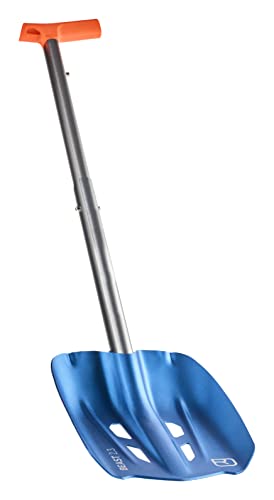
The Beast pairs the same 28 x 21 x 4 cm blade format as the Badger with a telescoping shaft, which makes it the more versatile of the two Ortovox mid-size shovels. The blade is hardened, anodized aluminum with high side walls and a long center ridge for stiffness, and the scoop holds 2.3 liters. Extended, the shovel reaches 83 cm for real digging leverage; collapsed to 42 cm, it fits smaller touring packs.
The hybrid T-grip Pro can be switched for left- or right-handed use, and the oval shaft cross-section keeps the grip aligned while you work. Non-slip step grooves on the blade let you add boot pressure in hard debris. At 580 g, the Beast sits in the middle of this guide on weight: lighter than the big-scoop Kodiak, heavier than the ultralight XLM, with a feature set aimed at everyday touring rather than a single extreme.
Specs
- Blade: hardened, anodized aluminum, 28 x 21 x 4 cm
- Scoop volume: 2.3 liters
- Shaft: telescoping, 83 cm extended, 42 cm packed
- Weight: 580 g
- Grip: hybrid T-grip Pro, switchable for left or right hand
- Traction: non-slip step grooves on the blade
Who it’s for / who should skip
For: ski tourers who want one shovel that balances packed size, digging leverage, and weight for daily use. Who should skip: rescuers who move snow in large teams and want maximum scoop volume, and minimalists counting every gram.
Ortovox Badger

The Badger is the simplest shovel in this guide: a fixed 70 cm shaft, a 2.5-liter scoop, and no telescoping mechanism to extend, jam, or ice up. It shares the 28 x 21 x 4 cm aluminum blade format with the Beast, including the center ridge and high side walls that keep the blade stiff in hard debris, and it packs down to 45 cm with the shaft removed.
An ergonomic hybrid grip gives several hand positions for right- and left-handed digging, and a centering aid in the shaft socket helps the two parts line up quickly during assembly, a small detail that matters when gloves are on and time is short. Non-slip step grooves round out the blade. At 625 g, the Badger is not the lightest option here, but its appeal is mechanical simplicity at a working length many diggers find comfortable.
Specs
- Blade: aluminum, 28 x 21 x 4 cm
- Scoop volume: 2.5 liters
- Shaft: fixed, 70 cm working length, 45 cm packed
- Weight: 625 g
- Grip: ergonomic hybrid grip
- Assembly: centering aid in the shaft socket
- Traction: non-slip step grooves on the blade
Who it’s for / who should skip
For: beginners building a first rescue kit and anyone who prefers fixed-shaft simplicity with a full-size blade. Who should skip: tourers who need a telescoping shaft to fit a compact pack, and diggers who want the extra leverage of a longer extended length.
Voile XLM

The XLM is Voile’s ultralight entry, built around a compact scoop cold-forged from 6061 aluminum and then heat-treated to a T6 temper. Cold forging work-hardens the metal, which helps a small, thin blade stay rigid when it is pried against hard avalanche debris. The handle does not telescope, keeping the design simple and the packed shape predictable.
At 526 g, the XLM is the lightest shovel in this guide, which makes it a natural fit for long tours, ski mountaineering, and races where every item in the pack is weighed. The trade-offs follow from the brief: a compact scoop moves less snow per pass than the larger blades here, and Voile does not publish blade dimensions or shaft length for this model, so pack fit has to be judged on the physical tool rather than a spec sheet.
Specs
- Blade: 6061 aluminum, cold-forged, T6 heat treatment
- Shaft: fixed, non-telescoping
- Weight: 526 g
- Blade dimensions: not stated
- Shaft length: not stated
Who it’s for / who should skip
For: ski mountaineers, racers, and long-distance tourers who put weight first but still want a forged metal rescue blade. Who should skip: anyone who expects to move large volumes of snow quickly, and buyers who want a telescoping shaft or a certified large-scoop tool.
FAQ
Why does an avalanche shovel need a metal blade?
Avalanche debris hardens quickly into dense, icy blocks. A metal blade can chop and pry through that material, while plastic blades flex, lose their edge, and can crack in very cold conditions. Every shovel in this guide uses an aluminum blade for that reason.
What does UIAA 156 certification mean?
UIAA 156 is the international standard for avalanche rescue shovels. It sets minimum requirements for blade size and for the strength of the blade and shaft under load. A certified shovel, such as the Kodiak above, has passed those tests; an uncertified shovel may still be strong, but its strength is not verified against the standard.
Is a telescoping shaft better than a fixed shaft?
Each design trades something away. Telescoping shafts pack shorter and extend for leverage, but add a locking mechanism that can ice up. Fixed shafts are simpler and assemble with fewer steps, but the shovel keeps its full length in the pack. The better choice depends on pack size and personal preference.
How should an avalanche shovel be carried?
Inside the pack, ideally in the dedicated avalanche tool compartment, with the transceiver and probe. The blade and shaft should be separated or collapsed so the shovel sits flat and can be pulled out and assembled quickly. A shovel strapped loosely to the outside of a pack can be torn off in a slide.
Final Verdict
There is no single best avalanche shovel here, only the best match for a style of travel. The Ortovox Kodiak is the pick for pure digging power, with the biggest scoop, UIAA 156 certification, and a hoe mode built for team rescue. The Voile Telepack suits travelers who value a flat-packing, two-piece design with anchor slots. The Ortovox Beast is the all-round touring choice, the Badger is the simple fixed-shaft option for a first kit, and the Voile XLM serves weight-first ski mountaineers. Whichever model you choose, carry it on every backcountry day and practice assembling and digging with it before the skills are needed for real.
Product and ASIN Reference
| Product | ASIN |
|---|---|
| Ortovox Kodiak | B071GS7L9Q |
| Voile Telepack | B01LY8CWC0 |
| Ortovox Beast | B07S37CCM1 |
| Ortovox Badger | B072KLLY6J |
| Voile XLM | B01LWLS6P6 |
More from Amazon
Programs that pair well with the guide above. Offers and eligibility are set by Amazon and may change.
Free shipping on eligible items, Prime Video and more. Eligible new members can start with a free trial.
Start a Prime free trialAudiobooks and podcasts to listen to on the go. Eligible new members can start with a free trial.
Try Audible freeAd-free music streaming. Eligible new subscribers can start with a free trial.
Try Music Unlimited freeA free business account with business pricing and bulk-buying tools for work, shop or home office.
Create a business accountAs an Amazon Associate we earn from qualifying purchases.
Write Your Review
No reviews yet. Be the first to share your experience!