
Key takeaways
- Shopping for the best tire chains for deep snow? Compare cable, link, Class S low-profile and self-tensioning chains, plus AutoSock snow socks.
Deep snow changes the math of winter driving. A tire that copes fine on a plowed street can spin uselessly on an unplowed grade, and all-season rubber hardens just when grip matters most. Tire chains remain the most effective short-term answer: they add biting edges that dig through loose snow to firmer ground, and in many mountain regions they are a legal requirement.
The catch is that chains are not one product. Cable chains, traditional link chains, low-clearance designs, self-tensioning sets and textile snow socks solve the same problem in different ways, and the wrong choice can rub a wheel well, ride terribly or fail to fit at all. This guide compares five proven options across those classes and explains how fitment sizing works for each.
As an Amazon Associate, we earn from qualifying purchases.
Quick answer
For most passenger cars, a low-clearance cable chain such as the SCC Super Z6 covers chain-control days without risking wheel-well damage. Truck and SUV owners who face unplowed roads get more bite from a cam-tightened link chain like the SCC Quik Grip QG2228CAM, while the self-tensioning Peerless Auto-Trac removes the worst part of fitting chains: re-tightening them in slush.
SCC SC1032 Radial Chain: the mainstream cable chain for passenger cars

The Radial Chain line from Security Chain Company is the classic budget-friendly cable design, and the SC1032 is a representative size in that range. Instead of heavy steel links, it uses steel cable side members with small traction rollers strung across the tread. The result is a light, compact set that rolls up small in the trunk, rides far smoother than a link chain, and asks for much less clearance.
Fitment approach: every SC model number in the Radial Chain line is built for a defined group of tire sizes. Find the size code stamped on your tire sidewall, match it against the fitment chart on the listing, and order the model number that lists your exact size, because a neighboring model number covers a different size group and will not fit.
Specs
- Steel cable traction chain with roller cross members; sold as a set of two for one axle; low-profile design for cars with limited clearance; fits the tire-size group assigned to model SC1032 in the listing chart.
Who it suits: Sedan and hatchback drivers who meet chain controls a few times a season on plowed roads and want something light, smooth and easy to store.
Honest limitation: Cable rollers cannot bite like real links. In deep, unplowed snow or on glare ice the SC1032 gives up ground to the link chains below, and the cables wear quickly once pavement shows through.
SCC QG2228CAM Quik Grip: heavy-duty link chains for trucks and SUVs
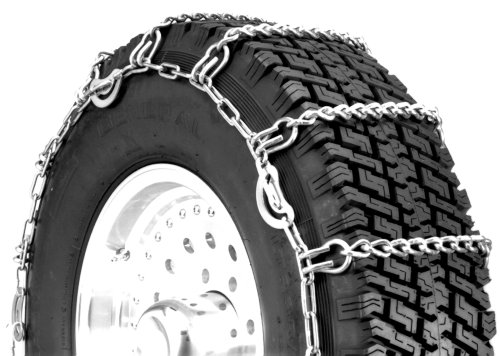
The Quik Grip QG2228CAM is the old-school answer for drivers whose roads do not get plowed promptly. It is a ladder-pattern link chain built from manganese alloy steel, with square cross links that present a hard edge to snow and ice. Tightening is handled by built-in cams turned with the included cam tool, so no separate rubber tensioners are needed.
Fitment approach: the QG2228CAM is one size in the Quik Grip light-truck range, and each model number maps to a specific set of tire sizes. Read your tire size code, find the model whose fitment list contains it, and select that model on the listing. Because link chains sit tall on the tread, also confirm your truck has the wheel-well room required.
Specs
- Ladder-pattern link chain in manganese alloy steel; cam tightening system with tool included; no separate tensioners required; sold as a set of two; does not meet SAE Class S limits, so it needs generous room around the tire.
Who it suits: Pickup and SUV owners on rural routes and mountain approaches where snow depth, ruts and slush reward a chain that digs rather than skates.
Honest limitation: The ride is rough, noisy and strictly slow, and the set is heavy to handle with cold hands. It is also the wrong purchase for any vehicle whose manual demands Class S equipment, because the links need more clearance than those cars have.
SCC SZ143 Super Z6: low-profile chains for tight-clearance vehicles
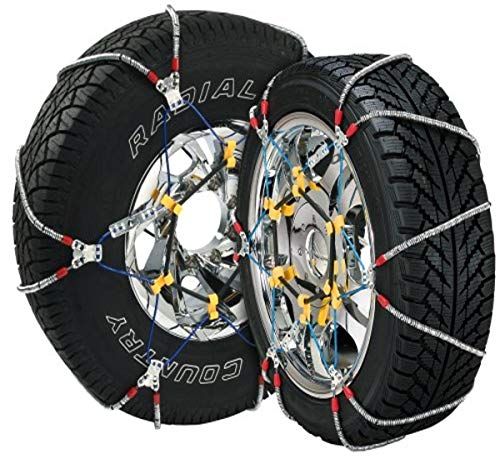
Many modern cars, crossovers and EVs have so little space around the drive tires that the manufacturer limits traction devices to SAE Class S, the tightest clearance class. The Super Z6 line was designed for exactly those vehicles. Its diagonal Z pattern uses low-profile cable with alloy traction plates, and it needs only about a quarter inch of operating clearance at the sidewall.
Fitment approach: the SZ143 is one size in the Super Z6 range, and the line splits fitment into many narrow size groups. Match your tire size code to the fitment chart on the listing and select the model that names your size. Installation does not require moving or jacking up the vehicle, and built-in tensioners keep the set centered.
Specs
- Diagonal-pattern cable chain meeting SAE Class S requirements; roughly 6 millimeters of sidewall clearance needed; self-adjusting tensioners built in; sold as a set of two; SZ143 covers the tire-size group shown in the listing chart.
Who it suits: Owners of late-model sedans, crossovers and EVs whose manuals restrict them to Class S devices, and anyone whose plus-size tires leave almost no room to spare.
Honest limitation: It is still a cable design, so deep unplowed snow and mud expose its limits compared with a true link chain, and the narrow size groups mean a careless size pick simply will not fit.
SCC Peerless 0231905 Auto-Trac: easy-install self-tensioning chains
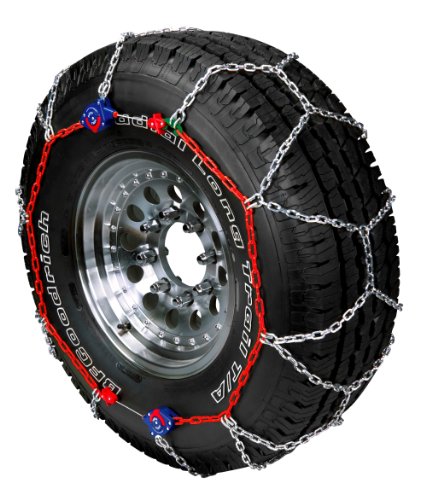
Fitting ordinary chains is a two-stage job: install, drive a short distance, stop, and re-tighten. The Auto-Trac system removes the second stage. Its patented ratcheting tighteners take up slack automatically while you drive, keeping the chain centered and snug without a roadside stop. The cross members are manganese alloy steel links in a diamond pattern, so traction is closer to a link chain than to a cable set, and the set installs without moving the vehicle.
Fitment approach: 0231905 is the light-truck and SUV size group in the Auto-Trac range; passenger-car sizes carry different model numbers in the same line. Check your tire size code against the fitment list on the listing and select the model that includes it. The design meets Class S clearance requirements for the vehicles it covers.
Specs
- Link-style chain with ratcheting self-tighteners; diamond-pattern manganese alloy cross members; installs without moving the vehicle; no separate tensioners needed; sold as a set of two; model 0231905 covers light-truck and SUV tire sizes.
Who it suits: Drivers who chain up often, travel alone, or simply refuse to kneel in slush twice per trip, including ski commuters on passes with frequent chain controls.
Honest limitation: The ratchets are moving parts that can pack with ice and road grit, so they need a rinse and a function check after use. Like every device here, it caps your speed at about 30 mph.
AutoSock HP697: textile snow socks, the chain alternative

The AutoSock is not a chain at all, and it should not be bought as one. It is a high-strength polyester textile cover that slips over the drive tires; the fabric fibers grip snow and ice, and the cover centers itself as you drive. The HP697 size is aimed at SUVs and light pickups, installs in minutes without tools or tensioning, adds almost no clearance, and is approved as a legal alternative to metal chains in many jurisdictions.
Fitment approach: AutoSock sizes are numbered, and each number covers a published list of tire sizes. The 697 covers a wide band of common SUV and light-truck sizes; confirm your exact size code appears in the fitment list on the listing and select size 697 only if it does.
Specs
- Woven polyester textile traction cover with elastomer elements; pack of two for the drive axle; self-centering fit; maximum speed 30 mph; size 697 fits the tire sizes listed for it on the product page.
Who it suits: Drivers whose cars cannot take metal chains at all, and anyone who wants emergency traction that goes on fast and stores flat.
Honest limitation: Fabric wears out quickly on bare or patchy pavement, so socks must come off the moment the road clears, and they give less purchase than steel in deep, unplowed snow. Approval also varies by checkpoint, so check the rules where you drive.
How to choose
Start with your owner’s manual, not with a product page. The manual names the SAE clearance class your vehicle can accept, and Class S is the restrictive one: it allows only a small amount of clearance at the sidewall and tread, which rules out most traditional link chains. If the manual says Class S, shop from the Super Z6, Auto-Trac and other Class S designs and ignore everything else. If the manual forbids chains outright, a textile device may be the only permitted option.
Next, confirm the exact tire size code before ordering. Chains are not universal: every model number above corresponds to a defined group of tire sizes, and a set that is one size off will be dangerously loose or impossible to close. Read the full code off the sidewall, including width, profile and rim diameter, and match all three numbers against the fitment chart on the listing.
Then choose the traction style honestly. Cable chains ride smoother, store smaller and cost the wheel well less, which makes them the sensible default for plowed roads and occasional chain days. Link chains bite harder in deep snow, ruts and mud, but they ride roughly, weigh more and need clearance many modern vehicles do not have. Self-tensioning link designs sit between the two on effort, and textile socks trade ultimate grip for ease and near-zero clearance.
Finally, practice fitting your set at home, on a dry driveway, before any trip. Every design here goes on twice as fast the second time, and the first time should not happen at night on a mountain shoulder. A home trial also confirms the size is right while returning it is still easy.
Who should skip
Skip chains entirely if your owner’s manual prohibits traction devices and offers no Class S allowance, since a damaged wheel well costs far more than a tow. Drivers in mild climates who see one dusting a year are usually better served by proper winter tires than by a chain set that lives unused in the trunk. Anyone unwilling to observe the roughly 30 mph speed cap should also pass, because every device here is built for slow progress. And if your vehicle is a heavy truck beyond the light-truck class, look at commercial-grade chain lines instead.
Frequently Asked Questions
How fast can I drive with tire chains fitted?
Plan on about 30 mph as the ceiling for every device in this guide, and slower in deep or rutted snow. The AutoSock lists 30 mph as its maximum, and chain makers give the same figure for cable and link sets. Higher speeds sling chains against the wheel well and can break a cross member, so treat the limit as absolute.
Do chains go on two tires or all four?
Chains fit the drive wheels: the front tires on a front-wheel-drive car, the rear tires on a rear-wheel-drive vehicle, one axle on most part-time four-wheel-drive trucks. All sets here are sold in pairs for a single axle. Full-time all-wheel-drive vehicles vary, so follow the manual; some makers specify one axle, others allow both, and a few prohibit chains completely.
Are snow socks legal where chain laws apply?
In many places, yes. AutoSock devices are approved as alternative traction devices in a number of US states and meet the European standard for textile traction aids, and they are accepted at many chain controls. Approval is not universal, though, and some checkpoints still insist on metal chains. Check the rules where you will drive before relying on socks alone.
Can tire chains damage my vehicle?
They can if the size is wrong, the fit is loose or they stay on over bare pavement. A loose chain can strike the wheel well, brake lines or suspension parts, which is why the size check and a re-tightening stop matter for manual designs. Correctly sized, properly tensioned chains used only on snow-covered roads at low speed are a normal, manufacturer-anticipated tool.
Final verdict
Match the device to your clearance class and your roads, and any of these five will do its job. Car owners with tight wheel wells should take the Super Z6, sedan drivers the Radial Chain SC1032, truck owners facing real snow depth the Quik Grip QG2228CAM, frequent chainers the Auto-Trac, and drivers who cannot use metal the AutoSock HP697. Whatever you choose, confirm the size code twice and practice once at home.
Product and ASIN Reference
| Product | ASIN |
|---|---|
| SCC SC1032 Radial Chain Cable Traction Tire Chain | B000VAKXVA |
| SCC QG2228CAM Quik Grip Light Truck CAM Tire Chain | B000VAJ17M |
| SCC SZ143 Super Z6 Cable Tire Chain | B000HZFDPU |
| SCC Peerless 0231905 Auto-Trac Light Truck/SUV Tire Chain | B003T6154W |
| AutoSock HP697 Snow Socks for Tires, Pack of 2 | B001MS229Q |
FAQ
How fast can I drive with tire chains fitted?
Do chains go on two tires or all four?
Are snow socks legal where chain laws apply?
Can tire chains damage my vehicle?
More from Amazon
Programs that pair well with the guide above. Offers and eligibility are set by Amazon and may change.
Free shipping on eligible items, Prime Video and more. Eligible new members can start with a free trial.
Start a Prime free trialAudiobooks and podcasts to listen to on the go. Eligible new members can start with a free trial.
Try Audible freeAd-free music streaming. Eligible new subscribers can start with a free trial.
Try Music Unlimited freeA free business account with business pricing and bulk-buying tools for work, shop or home office.
Create a business accountAs an Amazon Associate we earn from qualifying purchases.


Write Your Review
No reviews yet. Be the first to share your experience!