
Key takeaways
- Compare the best thermal socks for winter warmth: brushed-lining, merino and heavyweight boot picks that keep feet warm without sweat or bulk.
Cold feet can ruin a winter day faster than almost anything else. Whether you are standing on a frozen job site, sitting in a hunting blind, or walking the dog before sunrise, the right pair of thermal socks makes a bigger difference than most people expect. The problem is that “thermal” is one of the loosest words in the clothing business. It appears on everything from thick, brushed-lining socks built for serious cold to thin crew socks barely warmer than a summer pair.
This guide sorts through that confusion with five picks covering the main ways people actually stay warm: a brushed-lining sock that traps air, a merino blend that manages sweat, a heavyweight arctic sock for extreme cold, a tall boot sock for hunting and work boots, and a budget multi-pack for everyday wear. Each pick explains who it suits and where it falls short, because the warmest sock on paper is not always the warmest sock on your foot.
As an Amazon Associate, we earn from qualifying purchases.
Quick answer
For most people, the Heat Holders Original is the simplest route to warm feet: a thick acrylic sock with a deep brushed lining that traps air next to the skin. If you run hot or stay active, the COZIA merino blend handles sweat better. For bitter cold and tall boots, the Carhartt Arctic and the Carhartt boot sock below are the stronger picks.
Heat Holders Men’s Original Thermal Socks
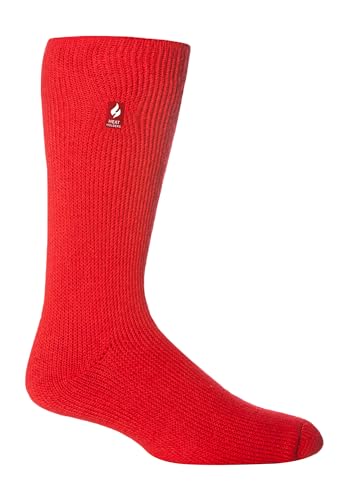
Heat Holders built its name on one idea: warmth comes from trapped air, and a brushed inner lining traps a lot of it. The Original is a thick crew sock made from an acrylic-rich thermal yarn, with the inside brushed into a soft, deep pile that feels almost like fleece against the skin. The brand rates it at 2.3 TOG, and whatever you make of TOG numbers (more on that below), the construction is genuinely different from a standard winter sock. The loft is obvious the moment you pick a pair up.
Specs
- Acrylic-rich thermal yarn; deep brushed inner lining; 2.3 TOG rating; crew length; men’s sizing fits US shoe sizes 7 to 12; sold as a single pair.
This is the pick for people whose feet get cold while standing still: outdoor workers on concrete, spectators at winter games, ice fishers, and anyone whose house runs cold. Because the insulation is mostly still air held in the pile, it works best at low activity levels where you are not generating much heat of your own.
The honest limitation is sweat. Acrylic does not move moisture the way wool does, so on a long, active day the lining can hold dampness against your feet, and damp feet eventually feel cold. The pile also compresses over time, so an older pair is less lofty than a new one. Treat this as a maximum-warmth, low-activity sock rather than an all-day hiking sock.
COZIA Merino Wool Socks

The COZIA is the counterpoint to the Heat Holders approach. Instead of trapping air in a brushed synthetic pile, it relies on a high merino content: 80 percent merino wool, with polyester, nylon, and a touch of spandex for shape and durability. Merino fibers absorb moisture vapor before it condenses on the skin and keep insulating even when damp. The result is a heavyweight sock that regulates temperature instead of simply maximizing it.
Specs
- 80 percent merino wool, 15 percent polyester, 4 percent nylon, 1 percent spandex; heavyweight knit; full cushioning; boot-friendly crew height; unisex sizing.
This suits hikers, skiers, and anyone who alternates between moving and standing around, because it handles that swing without the clammy feeling a synthetic sock can develop. It is also the better choice for multi-day wear, since merino resists odor far longer than acrylic or polyester, which matters on trips where laundry is not an option.
The limitation is care and delicacy. High-merino socks last longest when washed gently and kept out of a hot dryer, and even with nylon reinforcement they wear at the heel faster than a mostly synthetic work sock. If you want a pair you can throw in any wash load without thinking, this is not it.
Carhartt Men’s Arctic Heavyweight Merino Wool Blend Boot Sock

When the forecast drops well below freezing and you will be outside for hours, a regular heavyweight sock starts to feel thin. The Carhartt Arctic, model SB9110-M, is the brand’s warmest boot sock: a heavyweight merino wool blend with full cushioning through the foot and a boot-height leg, built for serious cold.
Specs
- Heavyweight merino wool blend; full cushion foot; reinforced heel and toe; boot height; men’s sizes Medium through X-Large; model SB9110-M; single pair.
This is the pick for snow removal crews, winter construction, late-season hunting, snowmobiling, and anyone wearing insulated pac boots in deep cold. The dense knit fills a boot properly, which matters more than people realize: a sock that is too thin lets your foot slide and leaves air gaps that chill, while this one takes up the space and keeps warmth where it belongs.
The trade-off is bulk and heat. In a snug boot, this sock can crowd your toes, and restricted circulation makes feet colder, not warmer. It is also too warm for mild days or heated indoor spaces. Buy it for genuine cold, and size your boots with room for it.
Carhartt Men’s Heavyweight Synthetic-Wool Blend Boot Sock 2 Pack

Tall boots create a specific problem: a crew sock ends halfway up the boot shaft, leaving a thinly covered calf and a sock top that works its way down into the boot. The Carhartt SB7742-M addresses that directly. It is a heavyweight boot sock sold as a 2 pack, blending polyester and wool with nylon for durability, cushioned at the heel, arch, and toe where work boots punish feet most.
Specs
- 54 percent polyester, 27 percent wool, 15 percent nylon, 2 percent acrylic, 2 percent elastane; heavyweight knit; cushioning at heel, arch, and toe; boot height; men’s sizes Medium through X-Large; model SB7742-M; 2 pairs per pack.
This suits anyone who spends long shifts in work boots, hunters in rubber or leather boots up to the calf, and riders whose boots reach mid-shin. The synthetic-heavy blend dries faster than a high-wool sock and shrugs off rough washing, which makes it a practical daily rotation sock rather than a special-occasion one.
The limitation is that the wool content is modest, so odor control and damp-warmth are a step behind the merino-rich picks above. The tall leg can also feel warm indoors, and if your boots are short hikers rather than full boots, the extra height is wasted fabric bunching at the top.
Dickies Men’s Heavy Weight Wool Blend Thermal Crew Socks

Not everyone needs a technical sock. If your goal is to get through a normal winter week of commuting, errands, and yard work with warm feet, a budget multi-pack makes more sense than one premium pair. The Dickies Heavy Weight Wool Blend Thermal Crew, style I21052, blends polyester with wool, nylon, and acrylic for a thick, cushioned crew that handles daily washing without complaint.
Specs
- 55 percent polyester, 19 percent wool, 14 percent nylon, 11 percent acrylic, 1 percent spandex; heavyweight cushioned knit; crew length; fits men’s shoe sizes 6 to 12; style I21052; sold in 2-pair and 4-pair packs.
This suits budget-conscious buyers stocking a drawer and anyone who wants a warm everyday sock for boots and shoes around town. The cushioning is genuinely thick for the class, and the high synthetic content means the socks keep their shape through repeated laundry cycles instead of bagging out at the ankle.
The honest limitation is that this is a compromise sock. The wool share is low, so sweat management and odor resistance are average, and it will not match the Heat Holders for still-air warmth or the Carhartt Arctic for deep cold. It is a sensible default, not a specialist, and heavy daily use will wear the cushioning down faster than the premium picks.
How to choose
Start with the fiber, because fiber decides how a sock handles sweat, and sweat management decides whether your feet stay warm after the first hour. Merino wool absorbs moisture vapor, keeps insulating while damp, and resists odor, which makes it the best all-round winter fiber. Its costs are real, though: merino socks need gentler washing, dry slowly on a line, and wear faster at the heel unless reinforced with nylon. Brushed acrylic, the Heat Holders approach, traps a thick layer of still air and feels warmer the moment you put it on, especially when you are standing still. But acrylic moves liquid sweat poorly, so on an active day that trapped warmth can turn damp and clammy. Match the fiber to how much you will be moving.
Be skeptical of headline warmth numbers. TOG is a laboratory measure of insulation borrowed from the duvet world, and there is no shared standard forcing every sock brand to measure it the same way. A high TOG figure usually just confirms a thick, lofty sock; it says nothing about how the sock behaves once your feet start sweating, and it cannot be compared cleanly across brands. Loft, fiber, and fit tell you more than the number on the packet.
Fit inside the boot is the factor most people get wrong. A thermal sock adds real volume, and if your boots were sized for thin socks, a heavyweight pair will compress your toes and slow circulation, which makes feet colder despite the extra insulation. Try winter boots on while wearing the thickest socks you plan to use. The sock should fill the boot without squeezing, and you should still be able to wiggle your toes freely.
Finally, manage moisture as a system. Start with dry feet and dry socks, change into a fresh pair at midday on long cold days, and never leave damp socks inside boots overnight. If your feet sweat heavily even in winter, favor merino and consider a thin liner sock under a heavyweight pair to move moisture away from the skin.
Who should skip
Skip thermal socks entirely if your winter is mostly heated offices and short walks from a car; a standard cushioned crew will be more comfortable and your feet will sweat less. Skip the thickest brushed and arctic picks if your boots already fit snugly, because crowding will make you colder. If you have diabetes or circulation problems, talk to a doctor before switching to very thick or tight-fitting socks. And if you mainly need warmth for high-output sports like running or hard skiing, look at sport-specific socks instead; most picks here are built for standing, walking, and working in the cold.
Frequently Asked Questions
Are thermal socks warmer than regular wool socks?
Usually, yes, but the gap is smaller than marketing suggests. A thermal sock is really just a sock designed to maximize insulation, through loft, brushing, or fiber choice. A heavyweight merino hiking sock and a mid-range thermal sock can perform very similarly. The biggest gains come from thickness and fit rather than the word thermal on the label.
How thick should thermal socks be?
Thick enough to fill your boots without squeezing your feet. For everyday winter wear in shoes or light boots, a midweight cushioned crew is plenty. For insulated boots and long hours in deep cold, heavyweight is worth it. If you cannot wiggle your toes, the sock is too thick for that boot, whatever the thermometer says.
Can I wear two pairs of socks instead of thermal socks?
You can, and a thin liner under a wool sock is a legitimate system that reduces blisters and moves moisture. But two ordinary cotton socks are a poor substitute: cotton holds sweat against the skin and loses insulation when wet. If you layer, make the inner layer synthetic or merino and the outer layer your warmest wool or thermal sock.
How should I wash thermal socks?
Turn them inside out, wash on a gentle cycle, and air dry or tumble on low. Heat is the enemy of both merino fibers and the elastic that keeps a tall sock up. Avoid fabric softener on merino, since it coats the fibers and reduces moisture handling. Brushed acrylic socks are more forgiving, but air drying keeps the lining loftier for longer.
Final verdict
For pure warmth at rest, the Heat Holders Original remains the easiest recommendation, while the COZIA merino blend is the better everyday and active choice. The Carhartt Arctic earns its place for genuine deep cold, the Carhartt boot sock 2 pack solves the tall-boot problem at work and in the field, and the Dickies multi-pack covers a whole drawer on a budget. Pick by fiber and fit first, and your feet will stay warm all winter.
Product and ASIN Reference
| Product | ASIN |
|---|---|
| Heat Holders Men’s Original Thermal Socks | B00J8JVCBK |
| COZIA Merino Wool Socks | B0927Q6H1B |
| Carhartt Men’s Arctic Heavyweight Merino Wool Blend Boot Sock (SB9110-M) | B09QLVFWJK |
| Carhartt Men’s Heavyweight Synthetic-Wool Blend Boot Sock 2 Pack (SB7742-M) | B09QLHLC42 |
| Dickies Men’s Heavy Weight Wool Blend Thermal Crew Socks (I21052) | B07VHYYG7D |
FAQ
Are thermal socks warmer than regular wool socks?
How thick should thermal socks be?
Can I wear two pairs of socks instead of thermal socks?
How should I wash thermal socks?
More from Amazon
Programs that pair well with the guide above. Offers and eligibility are set by Amazon and may change.
Free shipping on eligible items, Prime Video and more. Eligible new members can start with a free trial.
Start a Prime free trialAudiobooks and podcasts to listen to on the go. Eligible new members can start with a free trial.
Try Audible freeAd-free music streaming. Eligible new subscribers can start with a free trial.
Try Music Unlimited freeA free business account with business pricing and bulk-buying tools for work, shop or home office.
Create a business accountAs an Amazon Associate we earn from qualifying purchases.
Write Your Review
No reviews yet. Be the first to share your experience!