
Key takeaways
- Compare the best boot dryers for ski boots, from silent overnight convection models to fast forced-air dryers that handle two pairs plus gloves at once.
- Top Pick: DryGuy Force Dry DX Boot and Garment Dryer
- Runner-up: PEET Original Portable Electric Boot and Shoe Dryer
- Also consider: JobSite Silent Boot Dryer
A day on the mountain leaves ski boot liners holding more moisture than most skiers realize. Sweat soaks in from the inside, snow works in around the cuff, and by the time boots come off in the evening the liners are damp through. Left wet overnight, they start the next morning cold, clammy, and stiff, and over a season that constant dampness feeds odor and breaks down liner foam faster. A dedicated boot dryer solves the problem in the background: slide the boots on after dinner, and they are dry, warm, and ready before the first lift.
Boot dryers come in two broad families. Fanless convection models use a small heating element and rising warm air, so they run in complete silence but need most of the night to finish. Forced-air models add a fan that pushes heated air through tubes, cutting drying times to a few hours and often handling gloves as well. The five boot dryers for ski boots below cover both styles, from a four-port unit built for a whole family’s gear to a travel dryer that runs off a car outlet on the drive home.
As an Amazon Associate, we earn from qualifying purchases.
Quick answer
For most skiers, the DryGuy Force Dry DX is the pick to beat: its fan pushes warm air through four ports, so two pairs of boots, or boots and gloves together, dry in a few hours. If you want silent overnight drying instead, the PEET Original uses gentle convection with no fan and no noise at all.
DryGuy Force Dry DX Boot and Garment Dryer

The Force Dry DX is the fast option in this group, built around a central fan that circulates heated air through four drying ports at once. That capacity matters for skiers: one pair of boots can dry on two ports while gloves or a second pair of boots take the other two, so a couple or a small family can cycle through a full day’s gear in a single evening. The listing rates drying time at roughly one to three hours for typical footwear, a fraction of what a fanless unit needs.
Heat control is the other reason this dryer suits ski boots. A switch lets you run it with heat or with unheated air only, and the heated setting holds airflow at a gentle temperature that is safe for liner foams and heat-moldable materials. A timer with automatic shutoff at up to three hours means you can start it after dinner and forget about it. Included extension tubes raise the ports for tall ski boot cuffs, keeping air flowing to the toe area instead of pooling at the ankle. The trade-off is fan noise and a larger footprint, so it belongs in a mudroom, garage, or gear room rather than beside a bed.
PEET Original Portable Electric Boot and Shoe Dryer

The PEET Original is the classic fanless dryer, and it has stayed popular with skiers for a simple reason: it makes no sound at all. There is no fan and no motor. A heating element warms air inside the base, and that air rises naturally through two tubes into the boots, carrying moisture out the top. Because nothing moves, the dryer can sit in a bedroom or a small condo and work through the night without disturbing anyone.
Drying is gentle and slow. Damp liners typically dry in three to eight hours, so the routine is to mount the boots when you come off the hill and leave them until morning. The mild heat is safe for leather, synthetics, and delicate liner materials, and the low power draw makes it cheap to run every night of a trip. PEET builds the unit in the USA and backs it with a long warranty. What you give up is speed and features: there is no timer, no fan-only mode, and no capacity beyond one pair at a time. For a single skier or a couple sharing a quiet room, that simplicity is exactly the point.
JobSite Silent Boot Dryer
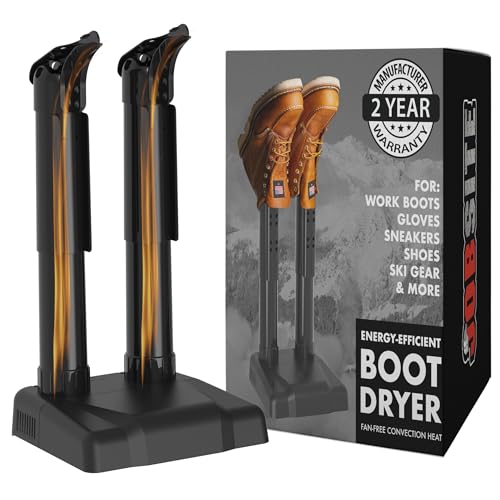
The JobSite Silent takes the same fanless approach as the PEET but adds a few practical touches. Its convection element draws very little power, an on/off switch with an indicator light replaces the plug-and-unplug routine of simpler models, and extension pieces are included for taller boots. The maker estimates about eight hours for damp footwear and up to twelve for fully wet boots, so like the PEET it is an overnight dryer rather than a quick fix between morning and afternoon sessions.
Where the JobSite earns its place is in shared and light-sleeping spaces. With no moving parts it is completely silent, and the gentle thermal air is marketed for gloves and removable ski boot liners as well as boots. It is ETL listed and carries a two-year warranty, reassuring for a device that runs unattended for hours. Capacity is one pair, and there is no timer, so plan on switching it off in the morning. Skiers who want quiet, low-energy drying for one set of gear at a time will find it covers the job without fuss.
KOODER Boot Dryer

The KOODER is the compact, simple entry in this group. Two short drying posts slide into the boots and warm them from the inside with a steady heating element, circulating warm air through the liner while helping to reduce the odor that builds up in damp footwear. There are no settings to learn and no fan to listen to; you plug it in, seat the boots, and let it work.
Its small size is the main appeal for travel. The unit packs easily into a boot bag or suitcase, so it can come along to a rental condo or a friend’s cabin where no drying setup exists. The honest limitation is pace and reach: the short posts suit everyday dampness from a day of skiing better than a fully soaked liner, and tall boots get less airflow at the cuff than they would from a full-height tube dryer. Think of the KOODER as a light-duty nightly dryer for skiers who travel often and want something small that keeps boots fresh and dry between ski days.
DryGuy Travel Dry DX Boot Dryer and Shoe Dryer
The Travel Dry DX answers a different problem: drying boots when you are nowhere near home. These compact inserts slip inside the footwear and blend a small fan with convection heat, warming air to a gentle level that DryGuy rates for drying in about two to five hours. The standout feature is the power supply, which works from a standard wall outlet or from a vehicle’s 12-volt outlet, so boots can start drying on the drive back from the resort.
At just over a pound, the pair of inserts disappears into a boot bag and takes up almost no room in a hotel bathroom or a crowded car. That portability comes with compromises worth knowing about. The short inserts reach the foot of the boot well but do not push air as high into a tall ski boot cuff as extension tubes do, and the maker notes the unit is meant for footwear rather than gloves. For road-tripping skiers who rotate between motels and rental houses, it is the most practical way to guarantee dry boots every morning of the trip.
How to choose
Start with drying style, because it decides both speed and noise. Forced-air dryers finish in a few hours and suit households that ski often or dry several pairs, but the fan hum rules them out of bedrooms. Fanless convection dryers are silent and gentle enough for any liner, yet they need eight to twelve hours on wet boots, so they only work if your routine gives them the whole night.
Capacity comes next. A two-port dryer handles one pair of boots, which is fine for a solo skier. Four-port models dry two pairs at once, or boots and gloves together, and that flexibility is worth having for couples, families, and anyone whose gloves come home as wet as their boots. Check tube or post height against your boots, too: ski boots are taller than hiking boots, and air needs to reach past the ankle to dry the toe box, so extension tubes matter.
Heat level and controls round out the decision. Look for a dryer whose heated air stays gentle, and prefer a heat-off setting if your liners are heat-molded or your boot maker warns against high temperatures. A timer with automatic shutoff adds safety and convenience for overnight runs. Finally, think about travel: a home unit can be bulky, while skiers who mostly stay in rentals should look at compact inserts and dual AC and car power options.
Who should skip
Renters can skip a boot dryer entirely, since rental shops dry and store their fleets between customers. Skiers who only get a handful of days each season may also find that pulling the liners and airing boots near a vent handles the job well enough. Anyone staying in backcountry huts or camping without reliable power has no way to run an electric dryer, and owners of a heated boot room or a dedicated drying rack already own the solution. A dryer also will not fix boots that leak through a cracked shell or a worn liner; that moisture problem needs a repair or a replacement, not warm air.
Frequently Asked Questions
Can a boot dryer damage ski boot liners?
A dryer made for footwear holds its air temperature at a gentle level that is safe for liner foams, leather, and synthetic shells. Problems come from improvised heat sources, such as hair dryers or radiators, which can concentrate far more heat in one spot. If your liners are custom heat-molded, choose a model with a no-heat or fan-only setting and follow your boot fitter’s guidance.
How long does it take to dry ski boots overnight?
Forced-air dryers usually finish a pair of damp ski boots in one to three hours. Fanless convection models work more slowly, needing roughly eight hours for damp boots and up to twelve for boots that are wet through. Both styles comfortably finish within a normal night’s sleep as long as the boots go on the dryer soon after you come inside.
Should I remove the liners before drying?
Removing liners speeds drying because air can circulate around them directly, and some dryers accept liners on their ports. Many skiers simply dry the whole boot with the liner in place, which works well overnight. Either way, open the cuff wide, loosen buckles, and take out the footbeds so moist air can escape instead of staying trapped in the toe.
Do boot dryers help with boot odor?
Yes, indirectly. Odor comes from bacteria that thrive in warm, damp liners, so drying boots fully after every ski day removes the moisture those bacteria need. A dryer will not rescue liners that already smell strongly; those need a wash or a deodorizing treatment first. Consistent nightly drying from the start of the season keeps odor from building up in the first place.
Final verdict
Match the dryer to your routine. The DryGuy Force Dry DX is the strongest all-around choice for homes and ski houses, thanks to four ports, a timer, and a heat-off setting that protects molded liners. The PEET Original and the JobSite Silent cover the quiet end of the range, the PEET with the longest track record and the JobSite with a switch, extenders, and a two-year warranty. Frequent travelers should look at the KOODER for its size or the Travel Dry DX for its car-outlet power. Any of the five beats leaving liners wet overnight.
FAQ
Can a boot dryer damage ski boot liners?
How long does it take to dry ski boots overnight?
Should I remove the liners before drying?
Do boot dryers help with boot odor?
More from Amazon
Programs that pair well with the guide above. Offers and eligibility are set by Amazon and may change.
Free shipping on eligible items, Prime Video and more. Eligible new members can start with a free trial.
Start a Prime free trialAudiobooks and podcasts to listen to on the go. Eligible new members can start with a free trial.
Try Audible freeAd-free music streaming. Eligible new subscribers can start with a free trial.
Try Music Unlimited freeA free business account with business pricing and bulk-buying tools for work, shop or home office.
Create a business accountAs an Amazon Associate we earn from qualifying purchases.


Write Your Review
No reviews yet. Be the first to share your experience!